What is APHon?
TL;DR
The Archipelagic Performance Histories Ontology (APHon) is a structured framework for organising and interpreting performance histories through an archipelagic lens. It helps describe performances not as isolated events, but as histories shaped by people, troupes, tours, places, communities, and supporting networks across interconnected worlds. Developed through research on the Straits of Malacca, particularly Singapore and Malaysia, between 1835 and 1975, APHon is designed to be extensible beyond that initial context. It brings together fragmentary and diverse sources in a structured way, supports comparative research, and encourages closer attention to what is documented, what remains uncertain, and how performance histories overlap, diverge, or unfold in parallel.
Overview
The Archipelagic Performance Histories Ontology, or APHon in short, is a structured semantic framework designed to describe, align, and map relationships across performance histories through an archipelagic lens. It supports the representation of performance-related knowledge through entities, properties, taxonomies, conceptual clusters, and controlled vocabularies, enabling fragmentary and heterogeneous materials to be organised, compared, and interpreted in meaningful and interoperable ways.
Why it matters
Performance histories are often scattered across different sources, formats, and descriptive systems. They may survive in newspapers, programmes, photographs, archival documents, oral histories, and other forms of evidence, often unevenly preserved and differently described.
APHon helps align these fragmented sources and diverse strands of scholarship, making comparative and cross-contextual research more possible. It also maps relationships among performances, performers, troupes, tours, places, communities, and support structures, while remaining attentive to uneven connections, partial overlaps, and histories that unfold in parallel rather than in direct relation.
Grounding context
APHon was first developed through research on the archipelagic regions of the Straits of Malacca, particularly Singapore and Malaysia, between 1835 and 1975. This historical and geographical focus provided the grounding context for the ontology’s development, shaped by intense cultural exchange and hybridisation, colonial transitions, and the flourishing of performative traditions including opera, puppetry, ritual, dance, and music. While developed from this scope, the ontology is designed to be extensible to other archipelagic and connected performance histories beyond its initial frame.
By structuring performances, persons, troupes, tours, places, communities, and evidence as distinct but related entities, APHon also supports critical consideration of gaps, absences, and parallel trajectories in the historical record. It makes it easier to register what is documented, what remains uncertain, and where histories overlap, diverge, or remain only partially connected.
Structure of the ontology
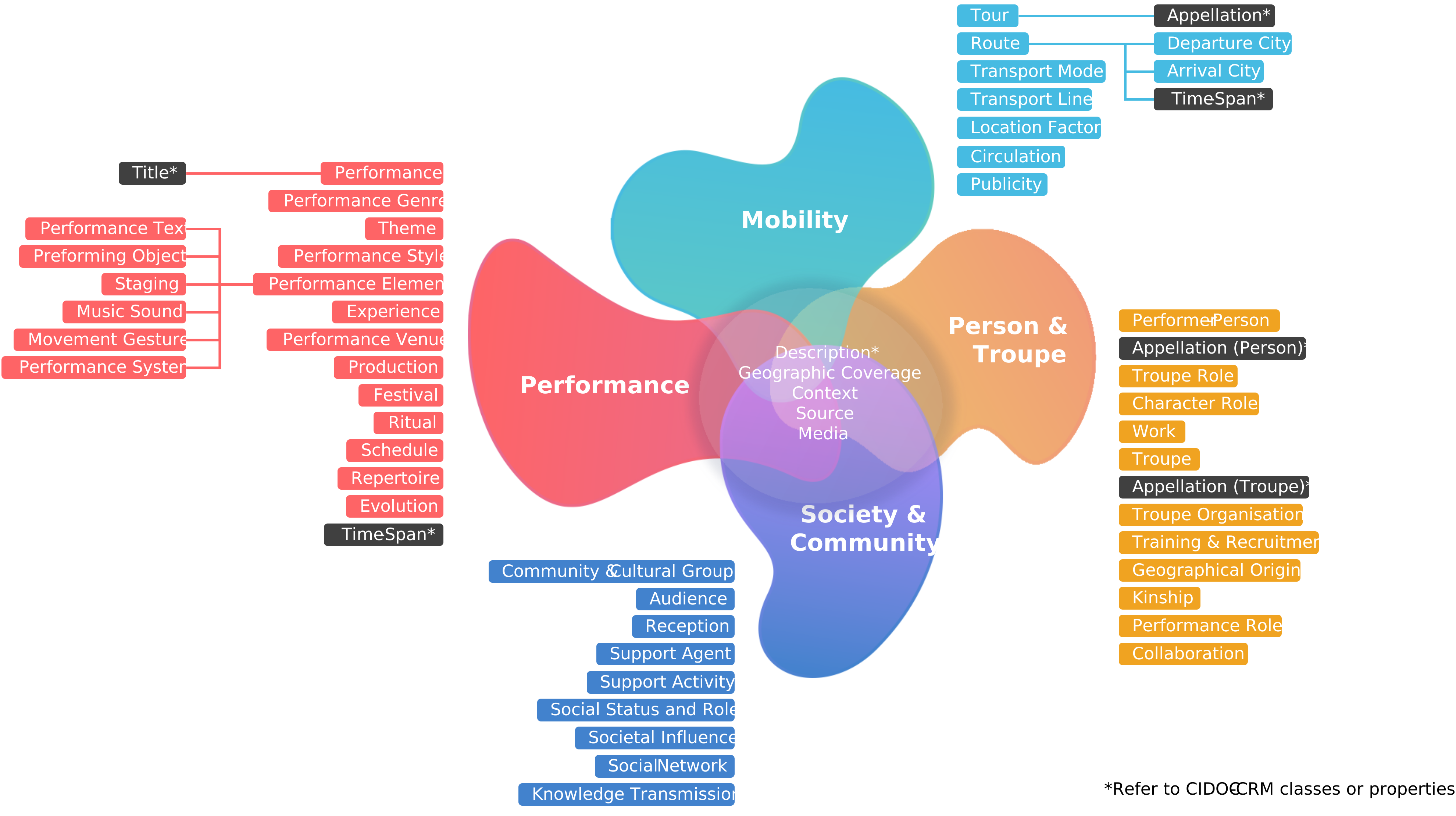
APHon is organised into four interlinked conceptual clusters, each built on CIDOC Conceptual Reference Model (CIDOC-CRM v7.1.3) classes and extended through domain-specific APHon subclasses and properties. These are supported by additional components—Description, Geographic Coverage, Context, Source, and Media—which enrich, contextualise, situate, and substantiate the data represented in the ontology.
Performance
At the heart of APHon is the Performance cluster, which captures the defining features of each performance. This includes names, genres, themes, styles, and other characteristics that shape a performance’s identity and significance. It also covers key performance elements such as texts, performance texts, performing objects, staging, and music.
By placing performances within events, productions, festivals, and rituals, and by attending to their historical and cultural contexts, this cluster supports a richer understanding of performance as both artistic expression and historical experience.
Person & Troupe
The Person & Troupe cluster focuses on the individuals and groups who create, sustain, organise, and transmit performance traditions. It includes performers, creators, organisers, supporters, and other contributors, together with their names, roles, biographies, works, and affiliations.
It also represents the identities and structures of performing troupes, including their organisation, training and recruitment practices, and support networks. This cluster highlights the collaborative and often collective nature of performance history.
Tour
The Mobility cluster focuses on the movement, circulation, and mediation of performance across interconnected archipelagic worlds. It documents the routes, infrastructures, and strategies through which performances, performers, and troupes circulated, as well as the broader conditions that shaped their movement and visibility.
This includes tours, routes, places and dates of departure and arrival, modes of transportation, and the lines and circuits that enabled movement. It also includes circulation mechanisms and publicity modes that helped performances travel across regions, reach different audiences, and gain visibility through multiple channels of dissemination.
Society & Community
The Society & Community cluster explores the reciprocal relationships between performances, performers, troupes, and the wider social worlds in which they were embedded. It considers communities, social groups, audiences, reception, support structures, social status, societal influence, and knowledge transmission, and examines how these shaped and were shaped by performance practices.
It also attends to the ways performance is sustained within communities, received by different publics, shaped by social identities and hierarchies, and transmitted across generations through formal and informal means. In this way, the cluster highlights the role of performance in identity formation, cultural continuity, social exchange, and the preservation or transformation of shared knowledge.
Supporting Classes
While not part of the four main clusters, Description, Geographic Coverage, Context, Source, and Media are essential supporting classes. Together, they ensure that the ontology remains detailed, evidence-based, spatially situated, and grounded in historical interpretation.
Description records overviews, notes, and contextual or biographical accounts. Geographic Coverage defines the spatial scope or territorial range in which a performance, tour, person, troupe, or production was active, influential, or present, whether across regions, clusters of cities, or named territories. Context captures the symbolic, cultural, historical, and thematic frameworks that shape other entities, including significant events, belief systems, ideologies, and conditions that motivate or frame artistic acts.
Source aggregates documentary and archival evidence related to performances, troupes, persons, venues, tours, or events. It includes textual sources such as archival records, interviews, reviews, and articles, as well as image and visual sources such as photographs, maps, paintings, illustrations, and digital media. Media gathers media representations of performances, troupes, and performers, including recordings, films, and photographs, which document how performances are remembered and distributed.
How it all connects
Together, these clusters offer a structured and nuanced way of examining how performances are created, circulated, supported, experienced, documented, and remembered across interconnected cultural worlds. Their interrelationships reflect the complexity of performance histories and the many layers of people, places, movements, infrastructures, communities, and records that shape them. More specifically:
Performances are created, staged, and sustained through the work of persons and troupes.
Persons and troupes move through and shape wider circuits of exchange through forms of mobility.
Mobility connects performances to different places, audiences, infrastructures, and channels of visibility, while also revealing patterns of circulation and uneven access.
Society & Community provides the social and cultural worlds in which performances are produced, received, interpreted, transmitted, and remembered.
Description, Geographic Coverage, Context, Source, and Media document, situate, and enrich these relationships, offering descriptive, spatial, evidentiary, and interpretive support for research and analysis.
In Summary
By bringing these dimensions together, APHon supports a wide range of research, from detailed archival documentation to comparative and transregional analysis. Developed from the study of the Straits of Malacca region between 1835 and 1975, but designed to extend beyond that initial scope, the ontology offers a framework for understanding how performance has shaped cultural memory, identity, mobility, and connected histories across archipelagic worlds.
Class and Property Usage
Radial network diagram showing the relationships between APHon classes with sample properties.
Explore the components of the APHon model below.