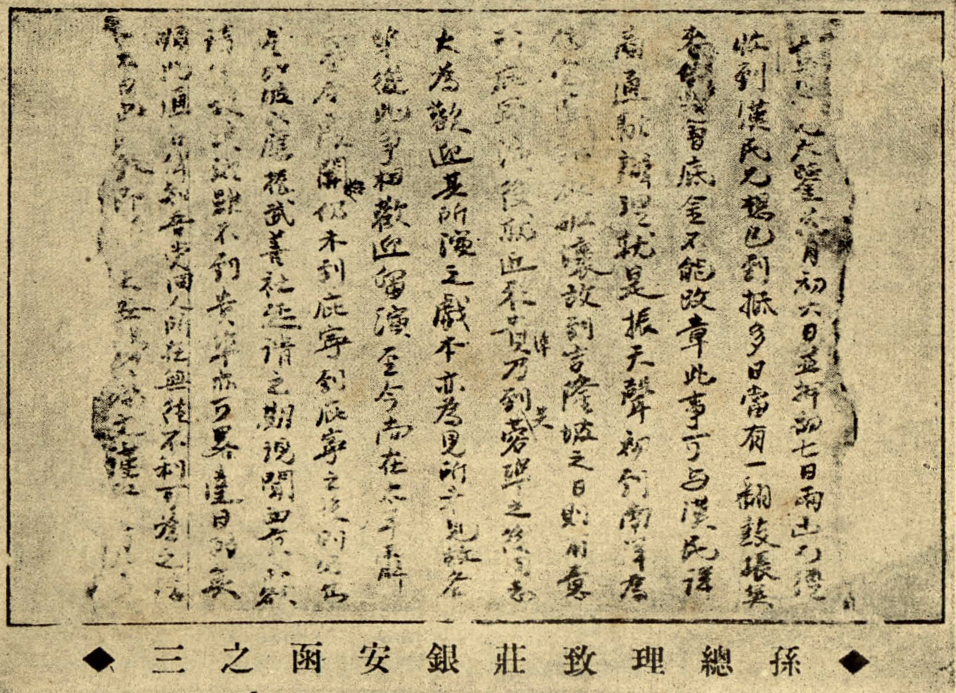
On Tuesday 14 December 1897, or the 21st day of the 11th month of the year of Guangxu Emperor, Tong Qing Teahouse (Chinese: 同慶茶園)[1] in Shanghai advertised in Shen Bao the staging of hua jing xi (畫景戲) by a troupe from Singapore (“星架坡”, an alternative Chinese transliteration of “Singapore”). “Spending a lot of money” to bring the “Singapore troupe” to Shanghai, another advertisement described the performance as a co-performance with local star actors. The performance featured hua jing (most likely painted backdrops) that depicted scenes of spirits, deities and buddhas emerging from the clouds.
The next day, a separate advertisement appeared in Shen Bao (Figure 1) with a more detailed description:
啓者近日星架坡新出一種畵景戱其中景緻活動如生大有巧夺天工之妙灵巧趣致難以细述不过將其大概情形略列奉闻凡演神祇仙佛化出雲頭
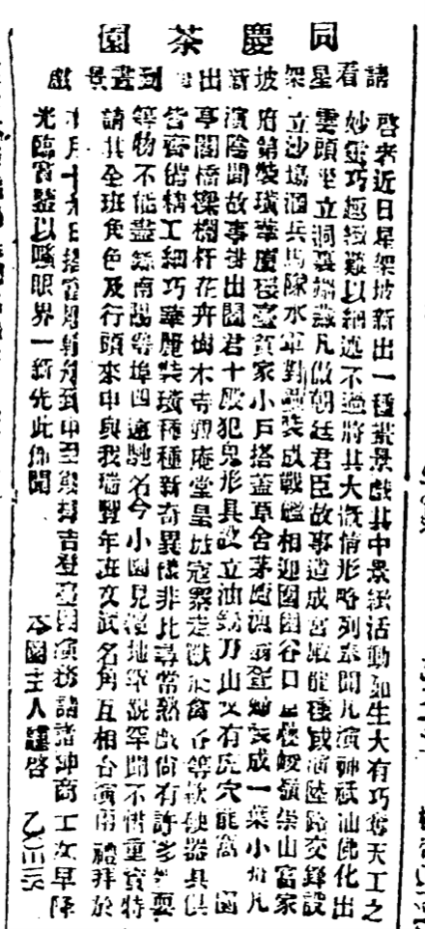
This joint performance put up by the Cantonese theatre troupe Feng Nian (丰年) and the nameless troupe from Singapore also used scenery pictures to depict a royal court, a dragon palace, a battleground, a mountain landscape, a mansion of a wealthy family, and even scenes from the ten courts of hell, such as the mountain of knives and boiling cauldrons. It would seem like multiple backdrops were prepared in advance and, depending on the setting of each scene, the backdrop would be used to depict the setting. This was, of course, a departure from the use of a table and two chairs that serve as a versatile setup. By moving and placing them in different ways, they can be reconfigured to symbolise different objects and scenes, such as a bridge or a bed, indoor or outdoor, a royal court or an altar of a rundown temple. The scenic backdrop introduced a different kind of versatility, and more importantly, added a visual component that framed the stylised bodies. And as the description in the newspaper publicised, the lifelikeness might have even surpassed audiences’ expectations, adding a touch of realism to the performance.
In “京剧舞台美术” [Jingju stagecraft] by Hede Gong, where he discusses the development of jingju in the late 19th Century, Tong Qing teahouse is briefly mentioned as emulating the new practice of using a rope to draw a curtain-like painted backdrop (屏风式绘景) in 1897.[2] Jingju would only begin to use painted backdrops in 1908, when the Shanghai New Theatre was established. From the above advertisements, film scholar Weihong Bao makes the claim that the “painted scenery play” was a technique imported from Singapore:
“Notably, the “painted scenery play” was described as a new stage technique from Singapore imported by an opera troupe from Canton, attesting to the transregional traffic in opera performance, scenic design, and stage renovation that intensified the interplay between “picture” and “play.”[3]
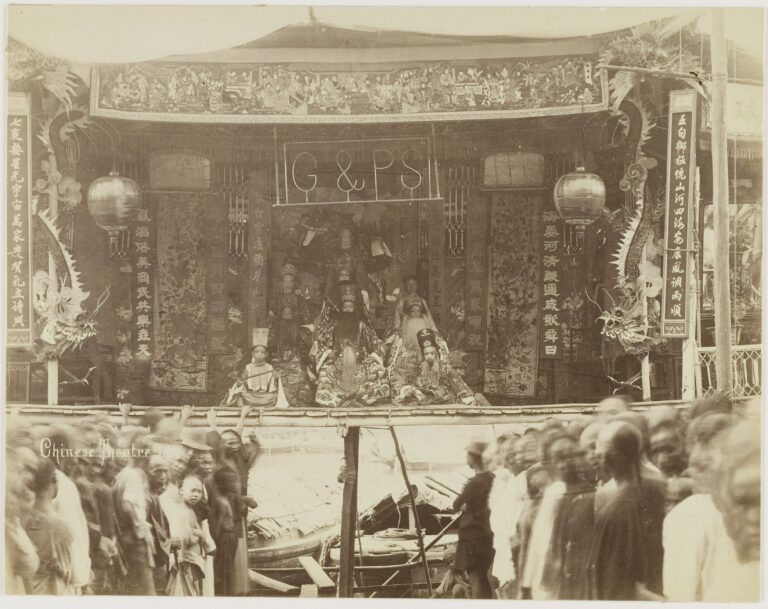
These few clues led me in search for the first troupe to use the “painted scenery” in Singapore. But none of these sources could tell me the actual name of the troupe that travelled to Shanghai in 1897. The only photographs I could find that suggest the use of embroidered curtains as both the backdrop and the entrances of exits are in the following two images (Figures 3 and 4).

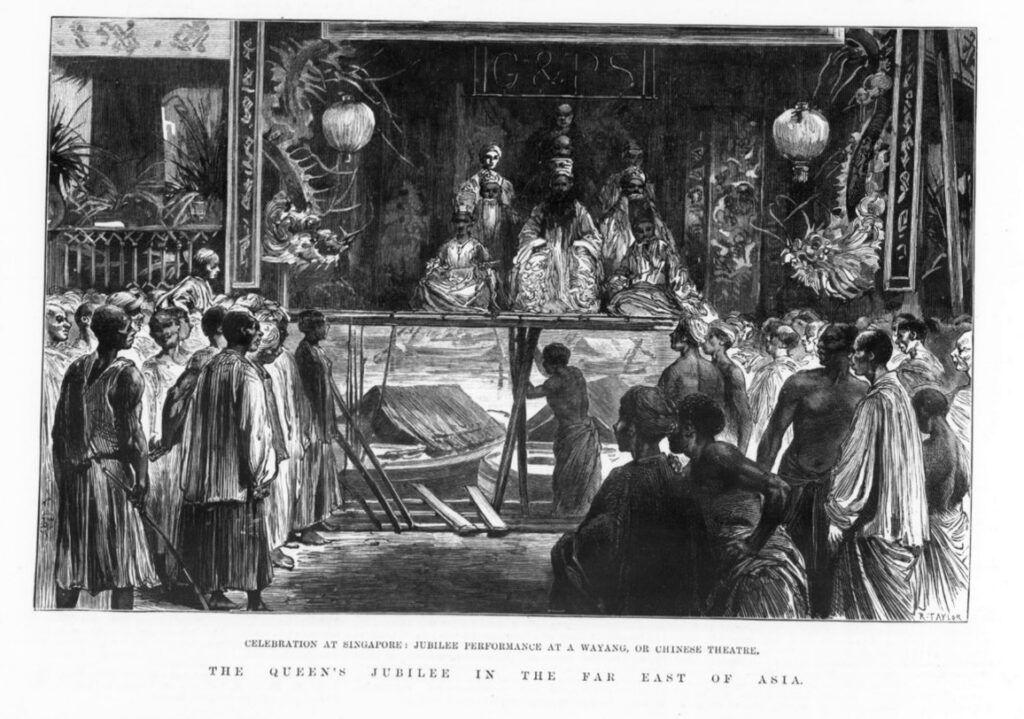
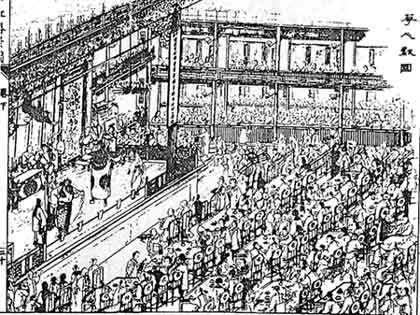
I have accessed Figure 3 from Leiden University Libraries, which states that the photograph was created around 1920. The photograph’s close resemblance to the illustration I accessed from The Illustrated London News in 1887, suggests that this was in fact a documentation of a Chinese wayang performance during the Queen’s Jubilee celebrations in Singapore in 1887. A correspondent in Singapore sent a photograph taken by G. R. Lambert to The Illustrated London News and an illustration was subsequently commissioned. Based on the report, it was likely a performance on June 27, 28 or 29, where “the Chinese were permitted to hold wayangs everywhere free”.[4] A decade prior to the 1897 performance in Tong Qing teahouse in Shanghai, I can already see in Figure 3 the use of a backdrop, which looks like a cloth backdrop with clouds and floral patterns.
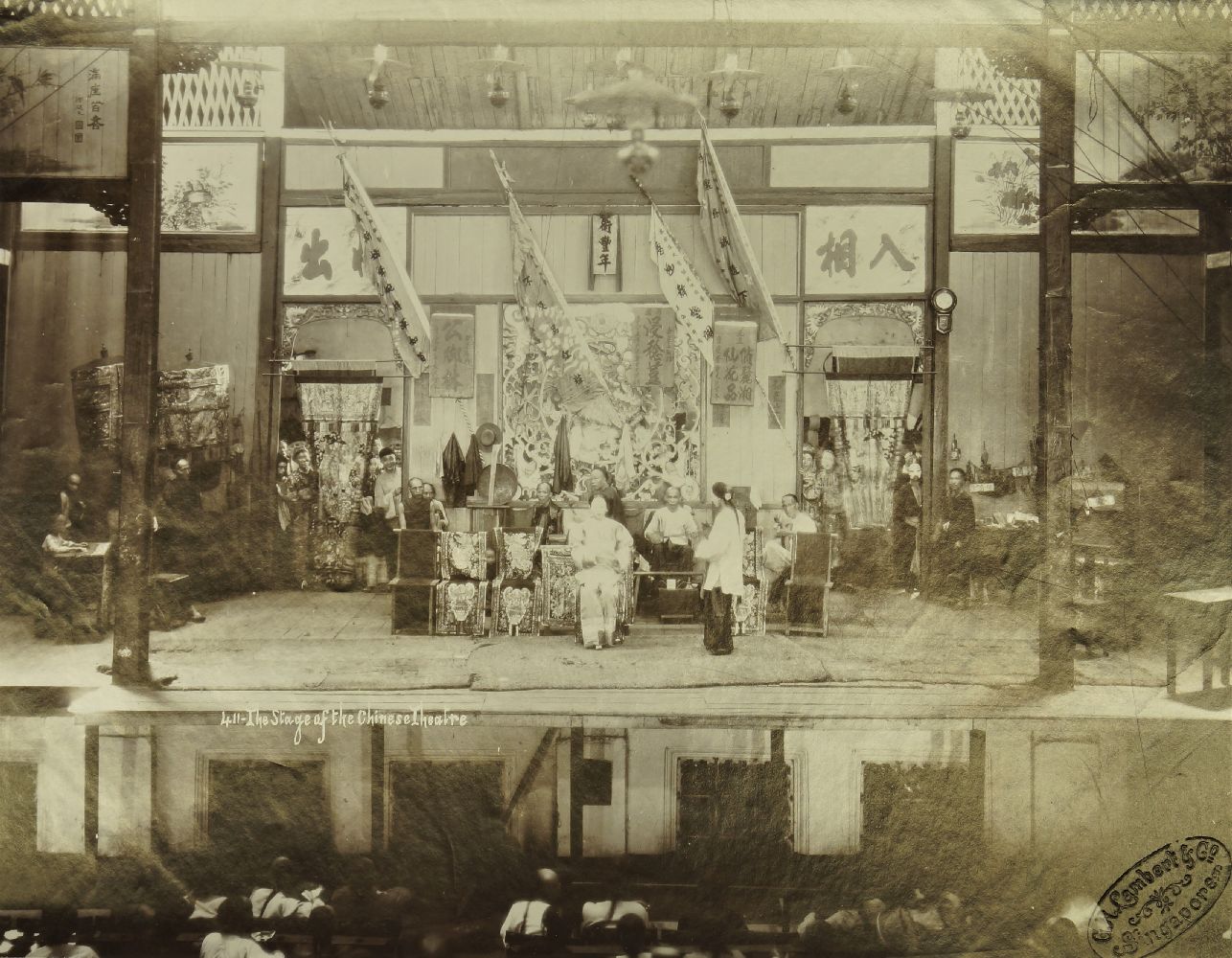
Figure 5. “The Stage of the Chinese Theatre”, G. R. Lambert
& Co. Singapore. Image: Roseberys.
Presumably taken in the 1910s, and another photograph taken by G. R. Lambert & Co., Figure 5 shows elaborate curtains obscuring the entrance and exit, and an intricately carved backdrop framing the performers. Taken together, these images hint at the décor of the theatre stage being the focal point, given that these stages were elevated. The high ceiling gas lights also suggest that the stage was equipped for night performances.
What do these illustrations and photographs say about the history of intermedial performance in Chinese street theatre in Singapore? It is well documented that xiqu played a crucial role in the development of Chinese film:
The importance of xiqu in the development of Chinese film is clear given that the first film made in China, the first sound film made in China and the first colour film made in China all used xiqu performance as their subject matter.[5]
Teahouses in Shanghai would later play a significant role in the history of early cinema in China. Besides staging Cantonese opera performances, they hosted European “technicians” who showcased the latest technologies at that time, for instance, the gramophone, proto-cinematic devices, and early film projectors. As Xu Peng points out, there is evidence of film projectors and phonograph machines being paired up and showcases at teahouses:
In teahouse ads in Shanghai Daily, we also see film projectors and phonograph machines as new technologies being paired up. As a marketing strategy this lexicon certainly attracted more attention; but the narration of the ads hints at teahouse audiences’ general expectation of continuous musical accompaniment to visual narrative, which was precisely one of the salient features of Chinese opera.[6]
Similar to Shanghai, teahouses in Singapore also served as venues for opera troupes; at the same time, the connection between film and theatre had a slightly different trajectory.
In 1896, the Kinetoscope arrived in Singapore and was brought by Dr Harley, an illusionist. Invented by Thomas Edison and William Dickson, it was a standing box that allowed a single person to view moving images through a peephole viewer. A review writes of Dr Harley’s exhibition at Messrs. Robinson’s music store from 13 July to 14 July 1896:
…this is not an imaginary scene from the brush of an artist, but is an accurate photograph of a scene that has taken place. The Gaiety Girls doing the carnival dance are perfectly lifelike, every movement every smile on the face; and the swish of the skirt are in full evidence. Within the cabinet is a small, but powerful electric motor—which runs a number of wheels and reels that carry a Photographic Film of celluloid having 1,400 photographs more or less on it.[7]
About a year later, on 20 May 1897, the Ripograph or Giant Cinematograph was brought from Paris by Mr. Arthur Sullivan to the Adelphi Hall in Singapore, which was:
a mechanical arrangement of instantaneous photographs taken at about twenty to forty exposures per second on a fine continuous film and from what could be seen, it gives a very accurate picture of animate existence. The pictures, projected by a magic lantern on to a screen in front of those present, give a natural appearance to the scenes depicted.[8]
Despite being two different contexts and mediums, both images were described as ‘lifelike’. The scenic backdrops used by an unknown Singapore troupe and the ‘animated’ photographs of the Ripograph seem to follow parallel trajectories at first glance, but I began to imagine possible scenarios where they merged and informed each other. Historically, however, the audiences that attended the technological exhibitions at the Town Hall Theatre or Adelphi Hall were the Europeans living in Singapore at that time. For instance, Mr Sullivan charged $1 for the front seats and 50 cents for the back seats, and drew the Europeans and perhaps the Chinese elite. A dollar at that time would be a day’s wages for a rickshaw puller. The working class would instead watch a wayang performance near the Singapore river for free, given that these performances were often commissioned by temples, Chinese businessmen and clan associations. Jonathan Sterne’s argument that “sound-reproduction technologies represented the promise of science, rationality, and industry and the power of the white man to co-opt and supersede domains of life that were previously considered to be magical” is equally applicable to photography and film-animation technologies.[9] That said, having search the newspapers at that time, the first introductions of a technology were often advertised as magical or even supernatural. For example, a certain Professor Douglas Archibald brought Edison’s phonograph to Singapore in 1892 and an advertisement was published about the “startling exhibition” with the tagline, “Voices from the Grave”.[10] In fact, there were many examples of European magicians or illusionists who demonstrated the “art of conjuring and some new Western technology including magnetism, the animatography, live photography, and the phonograph”.[11]
By relying on textual description and the few photographs and illustrations, I may have pieced together a narrative, but it still does not answer my central historical question: how did the painted scenery come about in Singapore? Without historical documentation, I have failed in documenting this important history. Nevertheless, this narrative is also an attempt to consider the use of pictures as iconographical documentation relevant to the theatre history of Singapore in the 1890s, a period which remains understudied despite being the period when theatre began to intersect with early cinema in the region. Citing Cesare Molinari, Christopher Balme writes:
Proceeding from the distinction between pictures as monumenti and documenti (the art historian is interested in the former, the theatre historian in the latter), Molinari elaborates three epistemological levels of iconographical documentation relevant to theatre history: direct, indirect, and documents representing an ideal concept of the theatre.[12]
Further, he summarises Molinari’s three levels:
- Direct documents are those where a direct and immediate relationship can be traced between the document itself and a specific theatrical event
- Indirect documents encompass those documents whose object is not exactly the theatre, but in which one can catch a glimpse of the contemporary theatrical practice
- The third category of documentary evidence refers to illustrated books, one of the most notoriously unreliable sources for the theatre historians in search of direct relationships.[13]
I take on board Balme’s suggestion to take more interest in the iconological potential of the pictures I used above:
What I am suggesting is that there should be more interest in the iconological potential of the images we deal with; that is in an interpretative approach to the theatre iconographical record. This means placing images in the centre of research, as the radial point from which historiographical endeavour can proceed.[14]
As a theatre historian, I study pictorial evidence not just in terms of its ‘documentariness, i.e., its function in reconstructing the theatrical past’ but to also consider how the pictures can be interpreted and retold as a narrative.[15] For me, the dragons at the wings of the stage in Figure 3, the supernatural forces and deities in the clouds as described in the Shen Bao advertisement, and the hanging acrobat in Figure 6 all point to past scenarios of labours in confluence with technologies. These are what Leo Cabranes-Grant might call “intercultural scenarios” that “demand a historiography of emerging identities because their repositions are primarily motivated by a desire to reactualize the past in terms of today’s work”.[16] As Cabranes-Grant argues, “Change and continuity are equally recalcitrant, and the challenge for the scholar is not to choose one over the other, but to travel along with both of them”.[17]
Starting with this imagery of supernatural forces framing the Cantonese opera performance and the photographic capturing of spirits through new technologies at that time, I travel along two islands—Singapore and Pulau Kusu—, a series of images of religious performances and street wayang in the Carl Alexander Gibson-Hill’s photographic collection (digitised and curated together through the efforts of Oh Soon-Hwa) and images collected by the National Archives Singapore. I see with a theatre-inflected gaze and imagine how they, at that time when early film in the 1920s were understood and translated as “影戏” or “shadow play” (literal translation), would suggest an interwoven relationship between theatre (or more precisely xiqu and puppetry) and moving pictures.
These photographs capture movements frozen in time as bodies enacted the entrances and exits of deities and spirits. Scenes of a littoral zone where boats and people gathered are followed by images of streets where the burning of incense blurred the figures of devotees labouring in the background. Liminal spaces as they were, ash and smoke remained as imprints of the residual force of rituals to transform spaces. These acts of worship were captured as stills, returning to tell us a repertory of stories in the present. By moving these images, I hope to illustrate the history of transregional connections where theatre meets picture, and picture meets the digital.
1
Photowayang
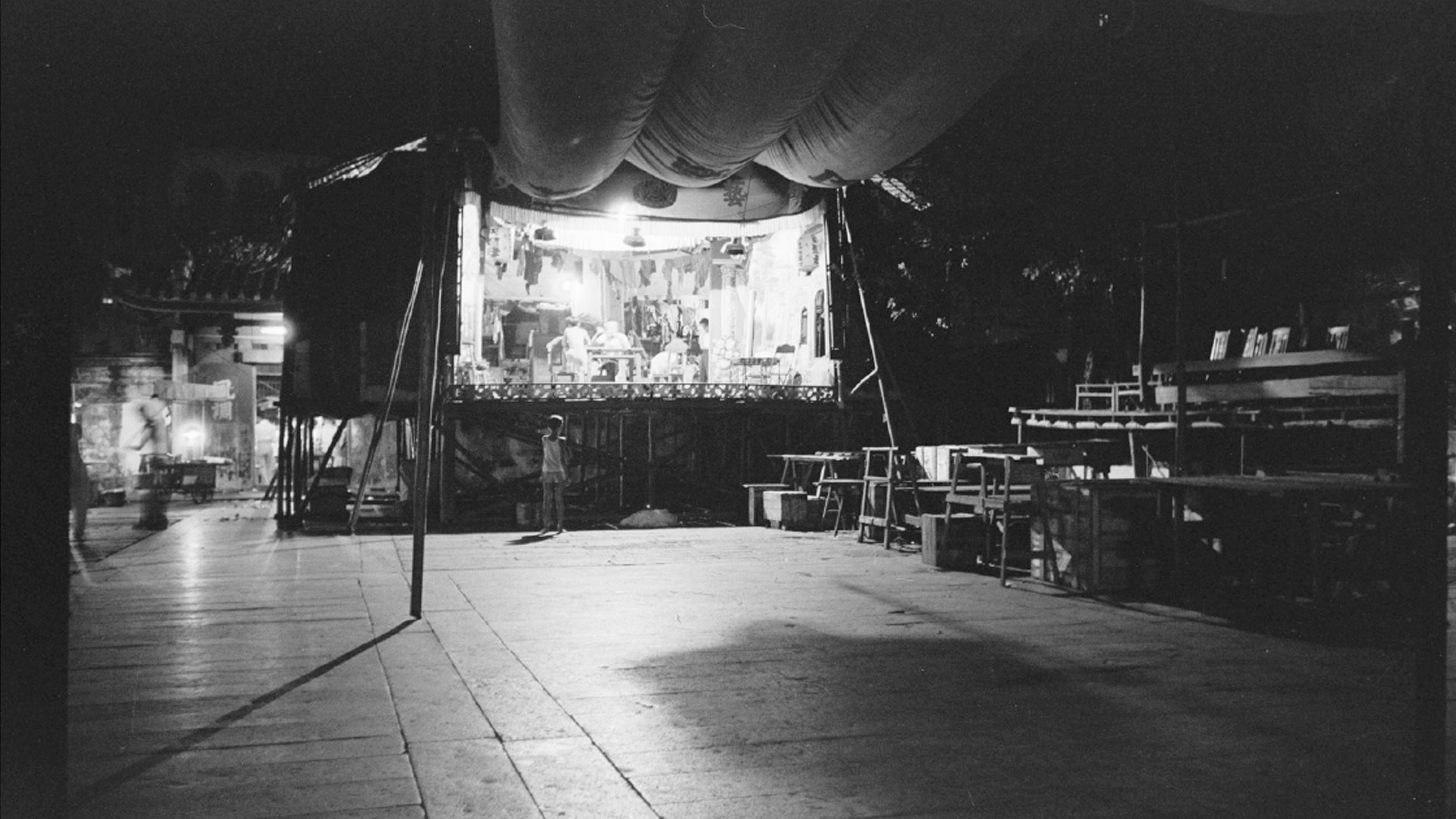
A painting of a Greek doric column seems to be placed on stage, though it is not clear if it was actually used as the backdrop.
More investigative work is needed to determine the Chinese temple. The wayang stage next to the temple suggests that the stage was set up for a religious festival, a ceremony, or to celebrate a deity's birthday.
Figure 7. A Chinese wayang stage, in the 1950s.
[Permission from the Gibson-Hill Estate from the Gibson-Hill photographic archive, Image provided by Associate Professor Oh Soon Hwa’s Liminal Landscapes Project][18]
Here is another image of a Chinese wayang performance, without context. There is no performance on stage. Instead, a senior figure sits behind a table on stage. Across him is a boy, with one leg on a chair and perhaps they are having a conversation. There is another boy watching them from below the stage, standing in what would have been the audience area. There is also a man with part of his body behind what seems to be a painted backdrop, which oddly enough looks like a decorative doric Greek column, its purpose and origin unknown. It might well be repurposed from a section of a bangsawan painted backdrop. My first clue is that bangsawan in the 1900s was already known to include Greek columns as an architectural feature of royal courts (Figure 8).

An oral history interview with Hamid bin Ahmad, who came to Singapore in 1945 to work, spoke of “performing tents for bangsawan were like the stages for Chinese wayang. If I’m not mistaken, they had agreements with the Chinese who built the stages”.[19] This adds to the possible reason for the painted set of doric columns on the Chinese wayang stage. An alternate source of early inspiration for the use of scenic backdrop could come from the arrival of the Komedie Stamboel in Singapore in 1894. Headed by Auguste Mahieu, a company of sixty-nine members traveled from Surabaya on the steamship Chiang Hok Kiang.[20] As Cohen describes, citing a Malay-language review:
… the stage is described as being “like that used for theater by White People at Town Hall,” Singapore’s major theatrical venue used by touring companies. “The painted backdrops [kain gambarnya[21]] are very attractive, like the Town Hall’s backdrops, or even more attractive. This theatre company performs in the manner of White People’s theatre, not like a circus. The dialogue is in Malay, but is a bit profound [dalam]. Costumes are excellent, and in my opinion like those used in Parsi theatre, with lots of beads. The songs are slow and elegant, and there are five or six players in the band. The band also plays slowly.”[22]
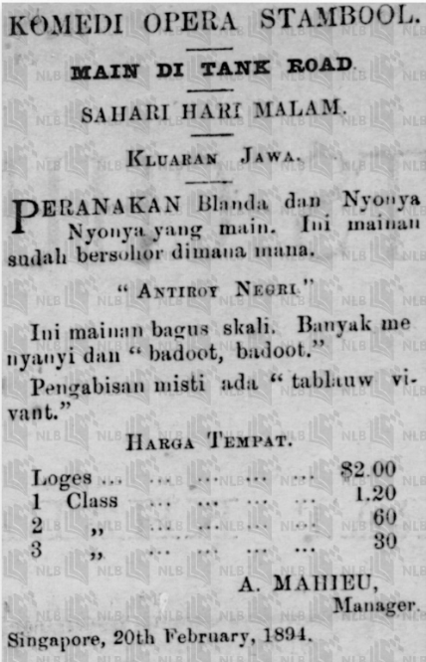
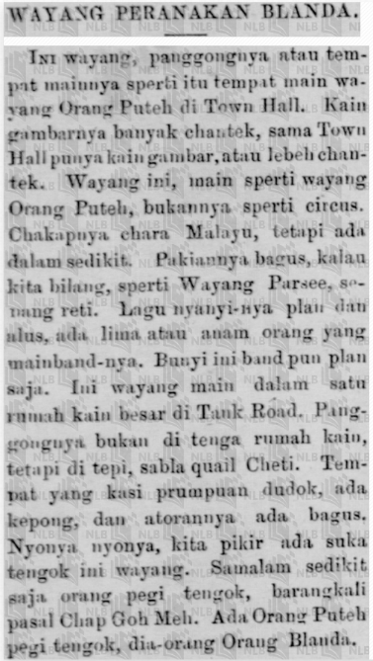
As Cohen explains, when Komedie Stamboel was owned by Yap Gwan Thay, he “had incorporated devices from the Komedie Stamboel into the Chinese opera troupes he owned as early as 1891, using scenic backdrops, concluding plays with tableaux vivants, changing traditional musical accompaniment to fit non-Chinese ears”.[23] Moreover, other Chinese opera troupes in Surabaya followed the example of Komedie Stamboel:
Tan Tjaij Howat’s Chinese opera troupe was credited in 1894 as using “scenery and equipment that could be said to be nearly the same as the Komedie Stamboel’s. He uses backdrops, and these backdrops are finely drawn.” The depiction of the punishments of hell in a production by Tan Tjaij Howat’s troupe was said to be “hair-raising in appearance.[24]
From this evidence, it is still difficult to determine the actual point of exchange and influence between Cantonese opera and the many itinerant troupes that were active in the 1890s. A year after the Singapore troupe left for Shanghai, a popular itinerant Parsi theatre company from India, the Victoria Theatrical Company visited Singapore in 1898 with its own technological device that produced “living pictures” (Figure 12).
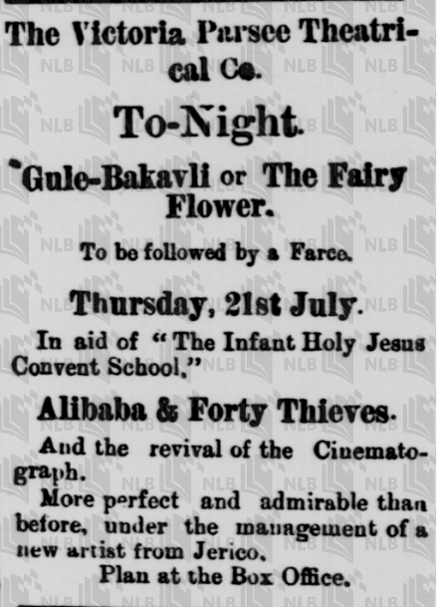
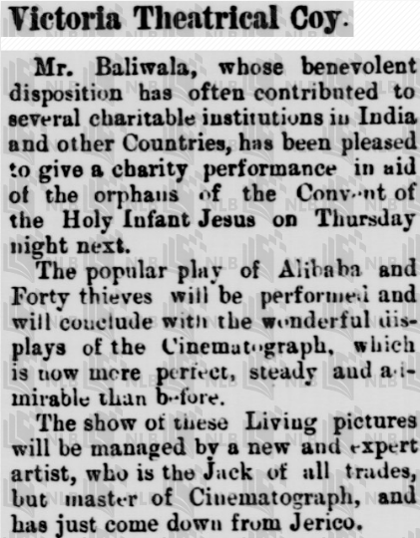
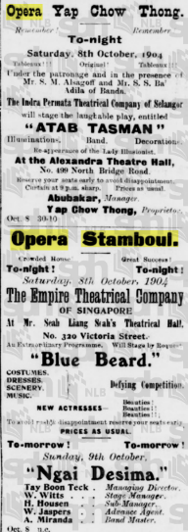
Nadi Tofighian points out that, “Film exhibitions arranged by a Parsi theatre company were once more technically proficient and well-received”.[25] This performance highlights the increasing porosity between theatre and photography, in which the theatrical spectacle was supported by the incorporation of new technologies. Six years later, in 1904, Chinese-owned bangsawan theatrical companies featured a mix of genres, staging conventions, and a mix cast of performers. The two advertisements in Figure 13 illustrate the extent to which forms were mixed, and in the case of Opera Stamboul (which sounds close to Komedi Stamboel) costumes, dresses, scenery and music were “defying competition”.
And this combination of backdrop spectacle and new technology culminated in the performances of a Cantonese opera troupe from Penang called Guangfuju (广福居). In one review of their touring performances in Singapore, in 1 June 1920, the reviewer writes:
“是晚所演,即人人共见共知之《杀子报》一出,戏文本极平常,惟竟能翻陈出新,于其中得三特色:一则域多利戏院之构造,与他院不同。剧场之上,见光而不见灯,更助以各色电光,与场上之画景,两相辉映,最足赏心动目,一特色也。” [26]
[The play performed that evening was the well-known “The Retribution for Killing the Son,” a play with a very ordinary script. However, it managed to be innovative and had three unique features: first, the Victoria Theatre’s structure was different from other theatres. The theatre had lights but we don’t see the lamps, and was further enhanced by various colored electric lights, which complemented the painted scenery on stage, making it a very pleasing and eye-catching feature.]
Notably, the second half of the performance, titled 《魂游地府》or spirits tour the underworld, the supernatural realm was described to “陆离光怪” or literally translated as “Fantastically colorful and grotesquely shaped”, suggesting a combination of coloured lights and costumed spirits on stage. This was indeed a mediated interface of technology and the supernatural, a theme I will return to.

2
Islands
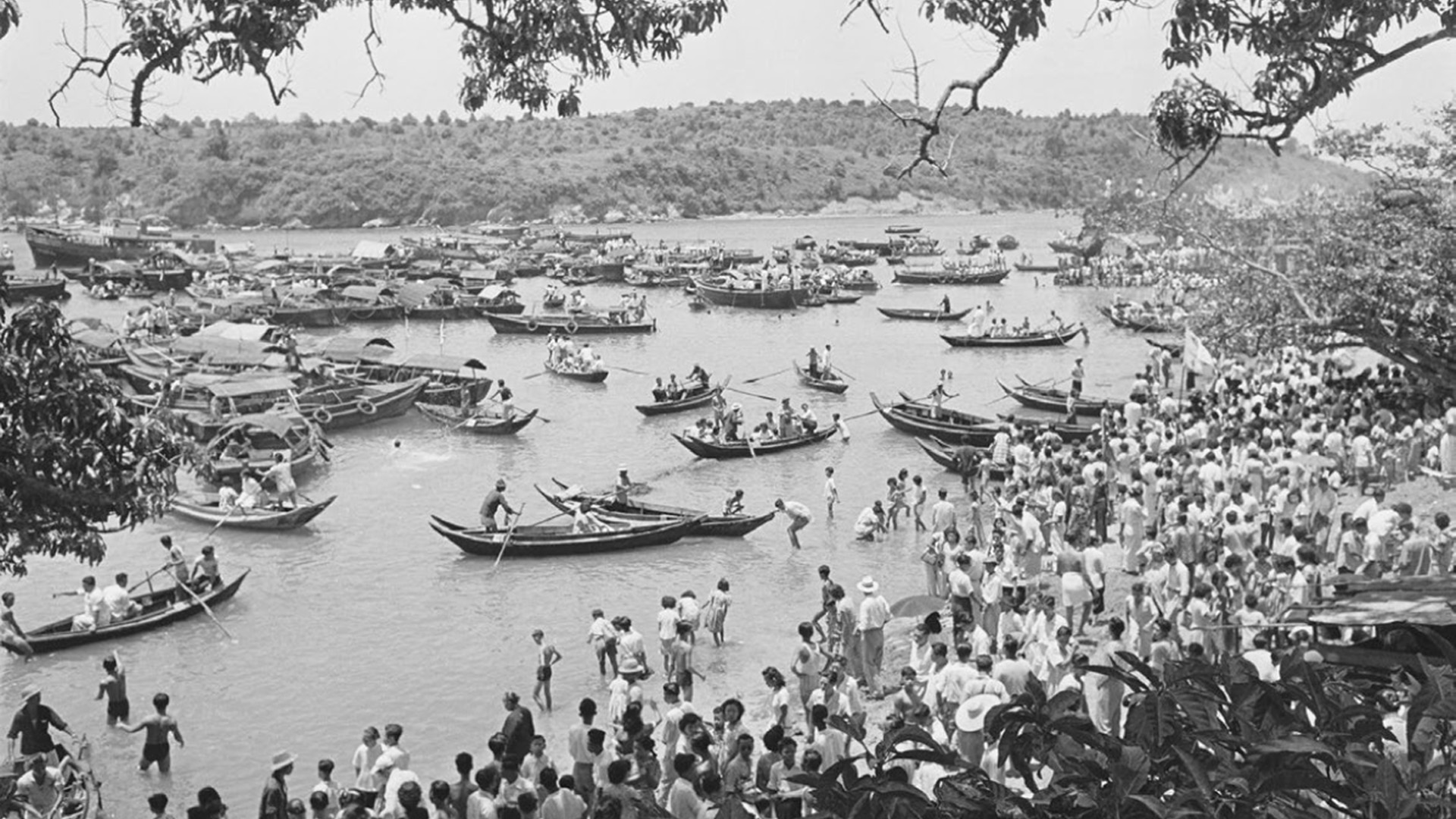
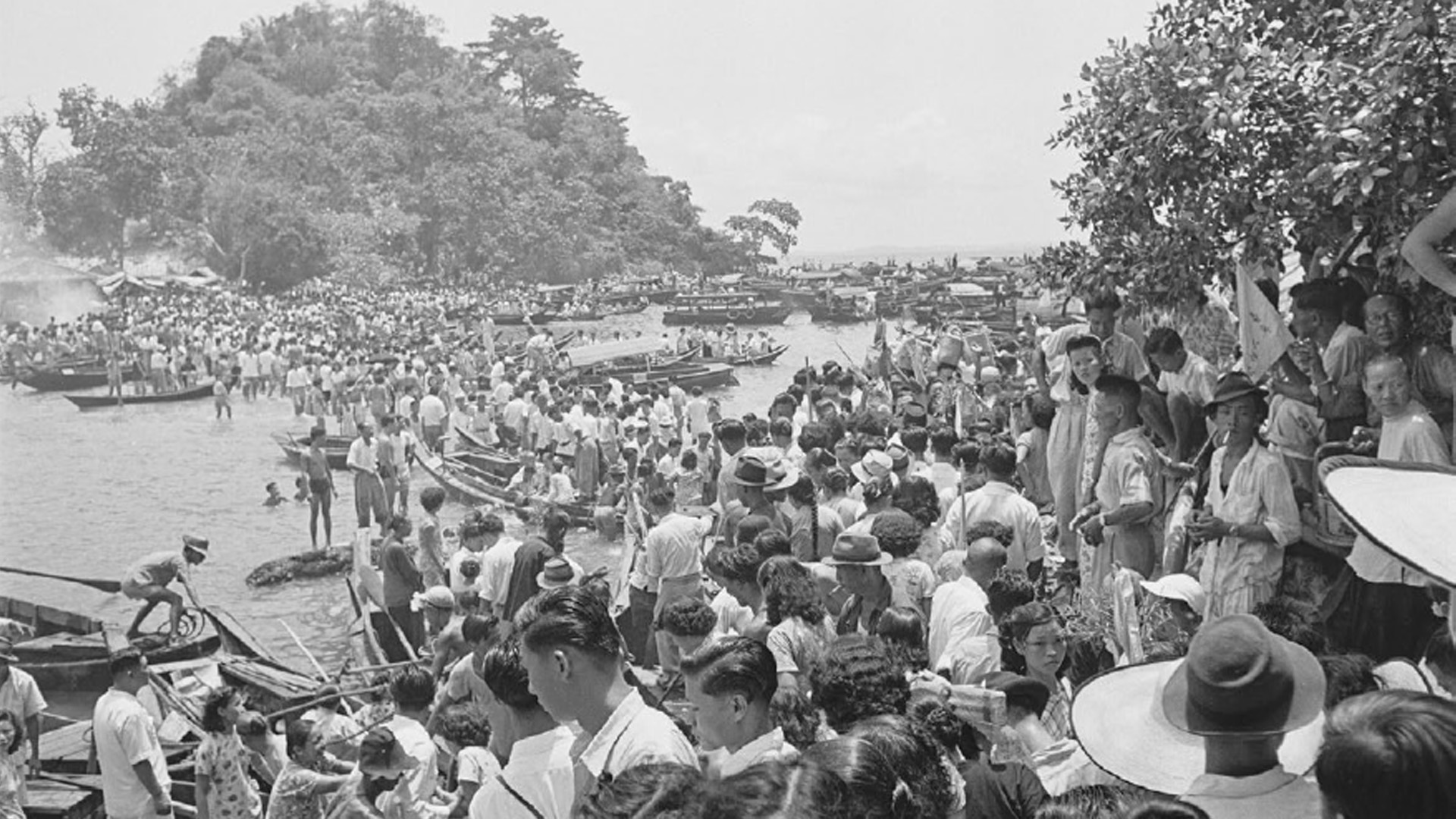
Figure 7 was taken by Carl Alexander Gibson-Hill, the last British director of Raffles Museum (today’s National Museum) in Singapore. In 1947, when he returned to Singapore after the second World War and over the course of sixteen years, he took a series of photographs of urban Singapore and colonial buildings, as well as river crafts, Indonesian trading boats and Chinese vessels, and most notably birds and fauna. Gibson-Hill was also interested in everyday life of locals, and several photographs captured a lost past where humans, spirits and vessels gathered on an island for a religious pilgrimage.
It was within this context of religious worship and festivities where I traced the history of Chinese wayang in Singapore, where temporary and transient theatrical spaces were erected and torn down to make their way to another location (such as the wayang stage you see in Figure 7). This littoral zone, like the makeshift stage and tent for Chinese wayang and bangsawan, performs the cross-cultural gathering of people and spirits. People and boats gather because gods arrive from the sea to this island, evoking the sea journeys that nineteenth-century migrants and gods made. Littoral zones are also transient spaces and gestures at both the cyclical nature of religious festivals and the transformation of spaces in Singapore. In the 1970s, the surrounding area of Kusu Island (also known as Tortoise Island, and formerly Peak Island or Pulau Tembakul) was reclaimed, and the narrow sand pathway which you see in the old image no longer exists; wooden boats have been replaced by ferries, which I took once in 2018 to visit the 100-year-old Tua Pek Kong Temple and the Keramat (or shrine of Datuk Kong) on Kusu Island. The scene here shows the height of the island’s importance as a pilgrimage site. Both photographs (Figures 14 and 15) from the Gibson-Hill collection show the hill where Keramat Kusu resides. What is behind the photographer, not captured, is the Tua Pek Kong temple. The two religious sites have remained on the island for more than 180 years for pilgrims to visit. During high tide, pilgrims had to cross between the two sites with boats.
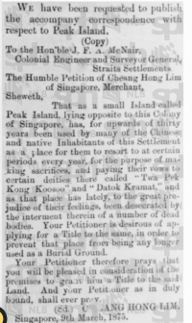
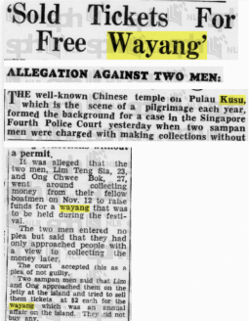
Figure 16. WEDNESDAY, 11th AUGUST. The Straits Times, 14 August 1875, Page 2
Figure 17. ‘Sold Tickets For Free Wayang’, The Straits Times, 10 December 1949, Page
A letter published in The Straits Times in 1875 suggests that the island had been, since the 1830s, “a place for them to resort to at certain periods every year, for the purpose of making sacrifices, and paying their vows to certain deities that called ‘Twa Pek Kong Koosoo’ and ‘Datok Kramat’” (Figure 16). I have yet to find out when the first wayang performances were held on the island, but an article in The Sunday Tribune on 29 September 1946[27] and in The Straits Times on 10 December 1949 tell us that they were long held during the annual pilgrimage and revived after the Japanese Occupation. What these records and photographs tell us is that there were strong connections between religious festivals and theatre. Serving the migrant communities at that time, wayang was the occasion to entertain and honour the gods, who themselves had established temples amongst these migrant communities. Kenneth Dean[28], for instance, has shown the enduring connection between the Chinese diaspora in Southeast Asia and their ancestral homes and deities, and points out that,
Thousands of Chinese temples, regional, clan, and trade associations have established networks across Southeast Asia, connecting in many cases back to ancestral communities in (mostly) South and Southeast China, or in other cases creating intra-Southeast Asian connections. […]
Each of the principal dialect groups that migrated out of Southeast China brought with them the main gods of their respective regional pantheons.[29]
As Dean explains, “Ritual specialists and ritual opera troupes increasingly make a circuit from Southeast China through their respective networks in Southeast Asia, timing their itineraries to coincide with the birthday festivals of the gods”.[30]
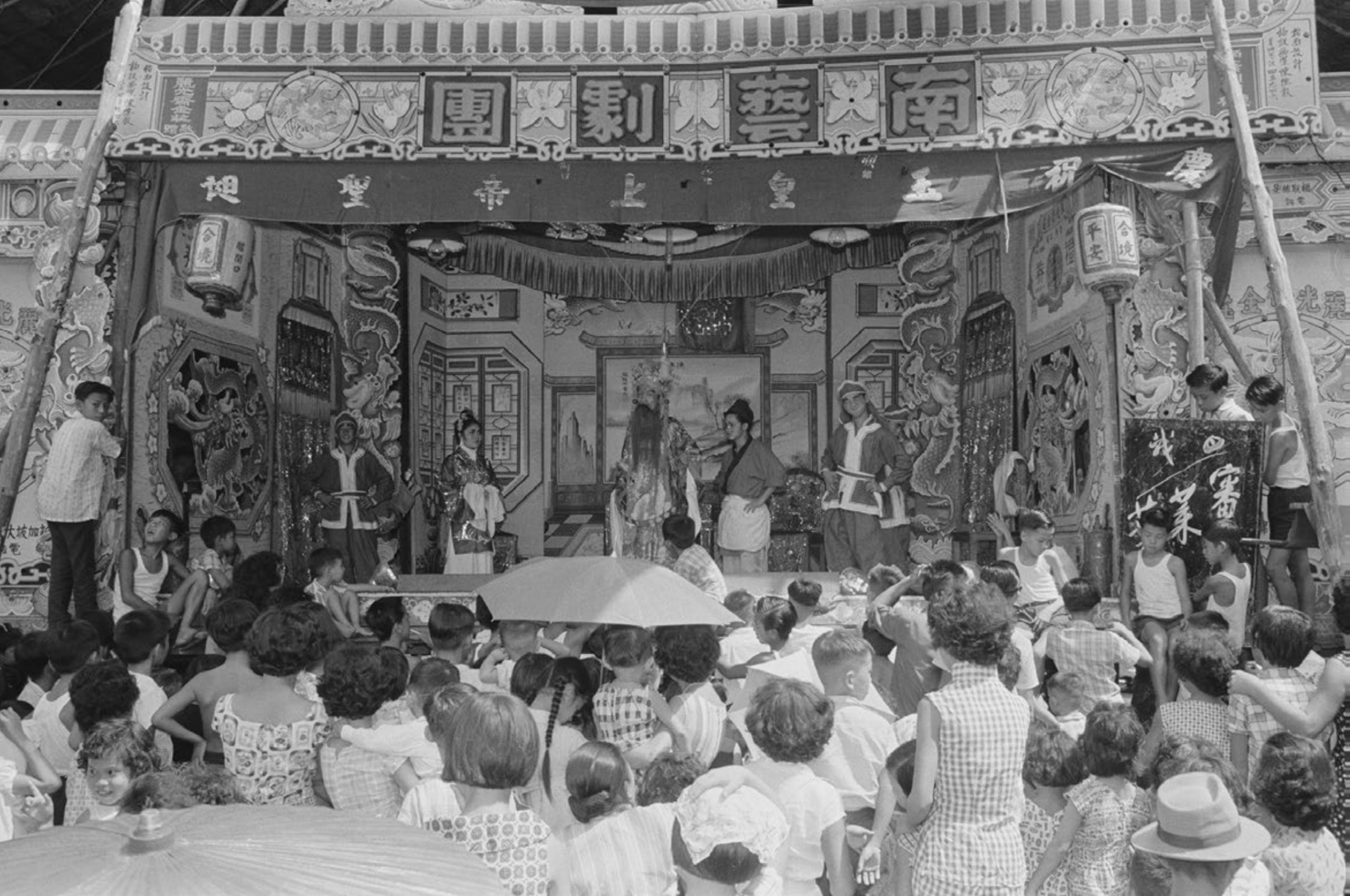
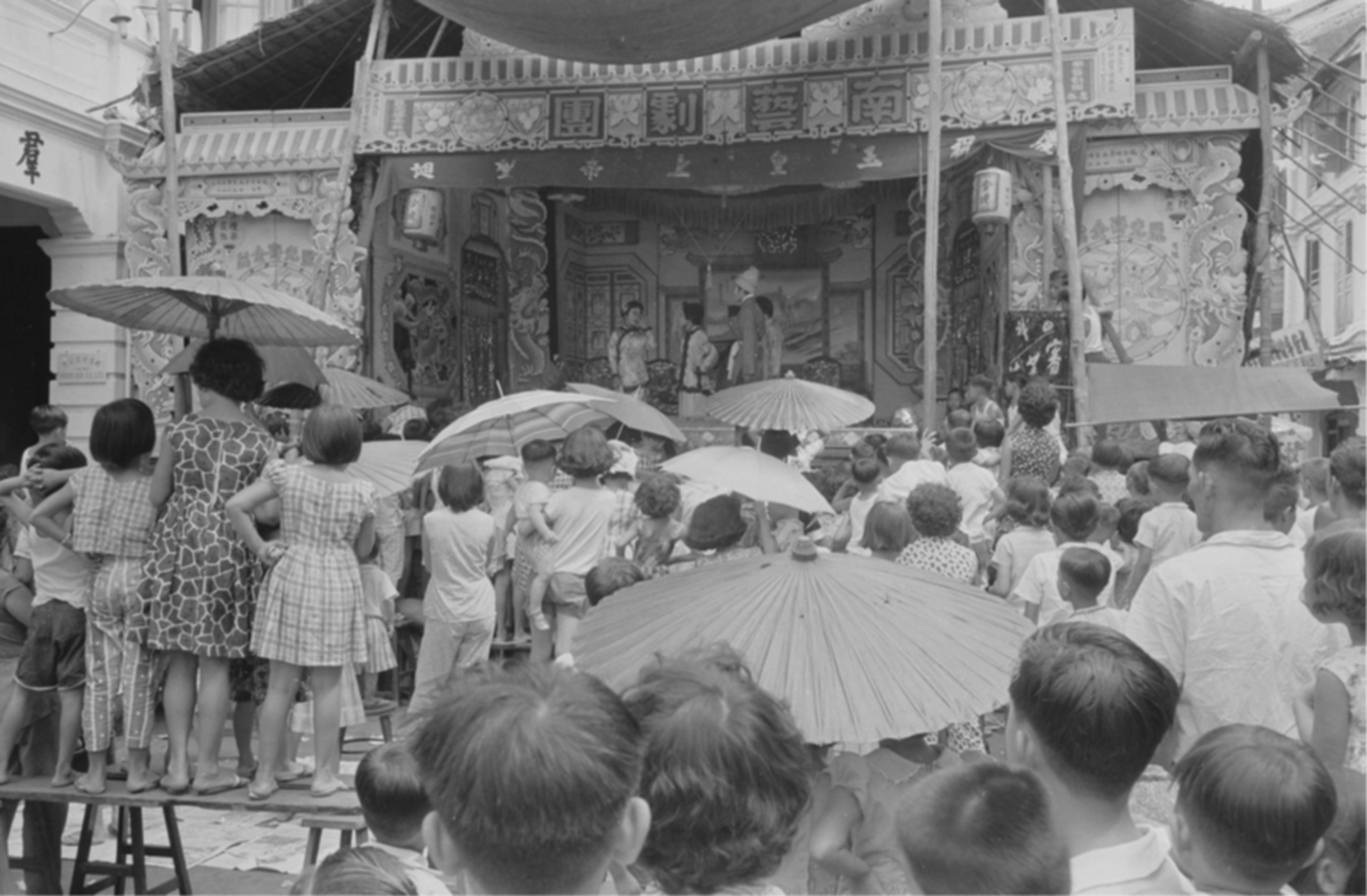
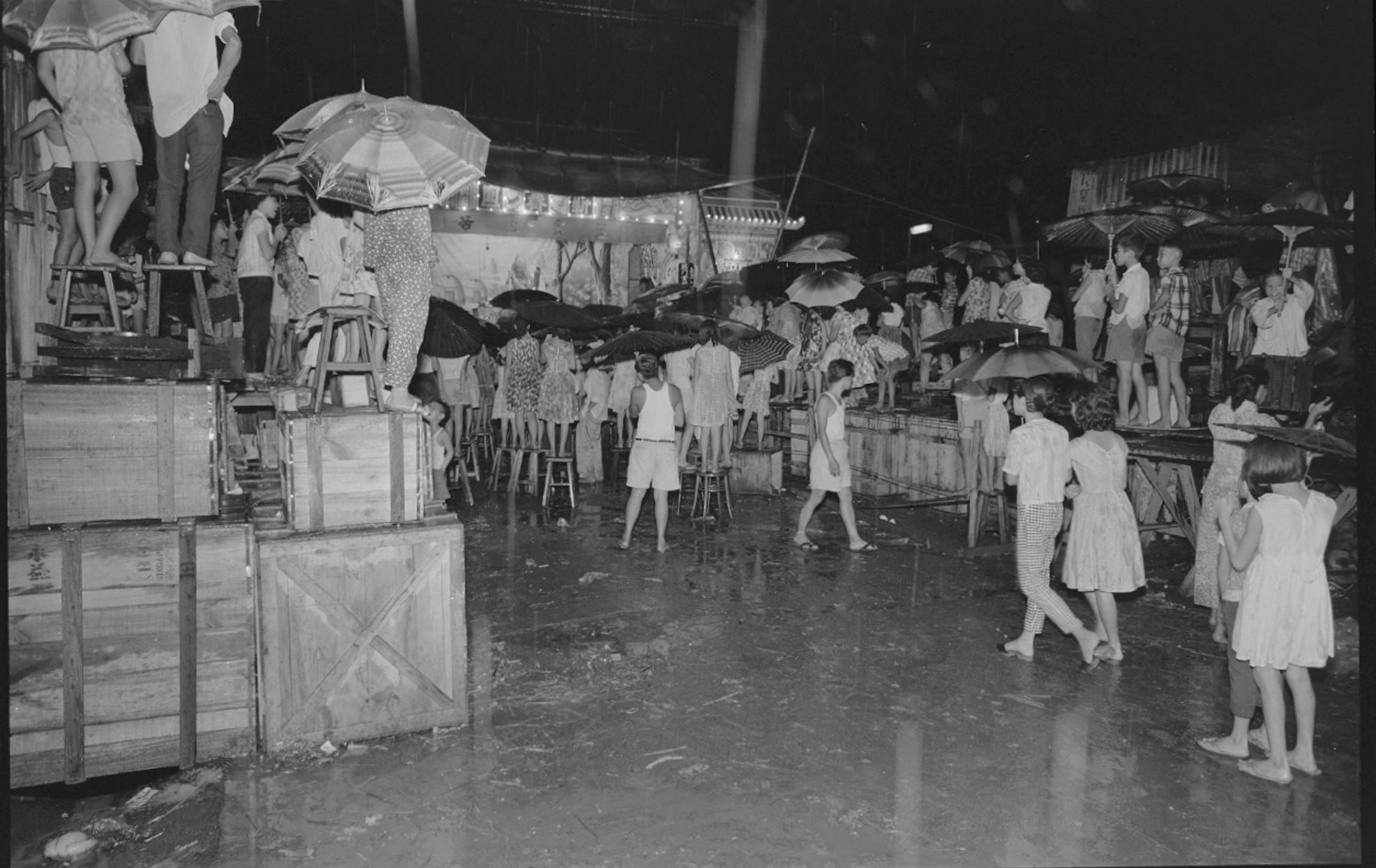
Figures 18 and 19 bear witness to the prevalence and popularity of street wayang in Singapore as entertainment for the gods for more than a century since the early waves of Chinese migration. In both photographs, I can see the extensive use of backdrops to show the inner décor of the house. Now, instead of cloth backdrops, wooden boards were painted over to resemble the façade of a Chinese mansion. I also see the gaze of the audience members looking at the camera of Gibson-Hill.
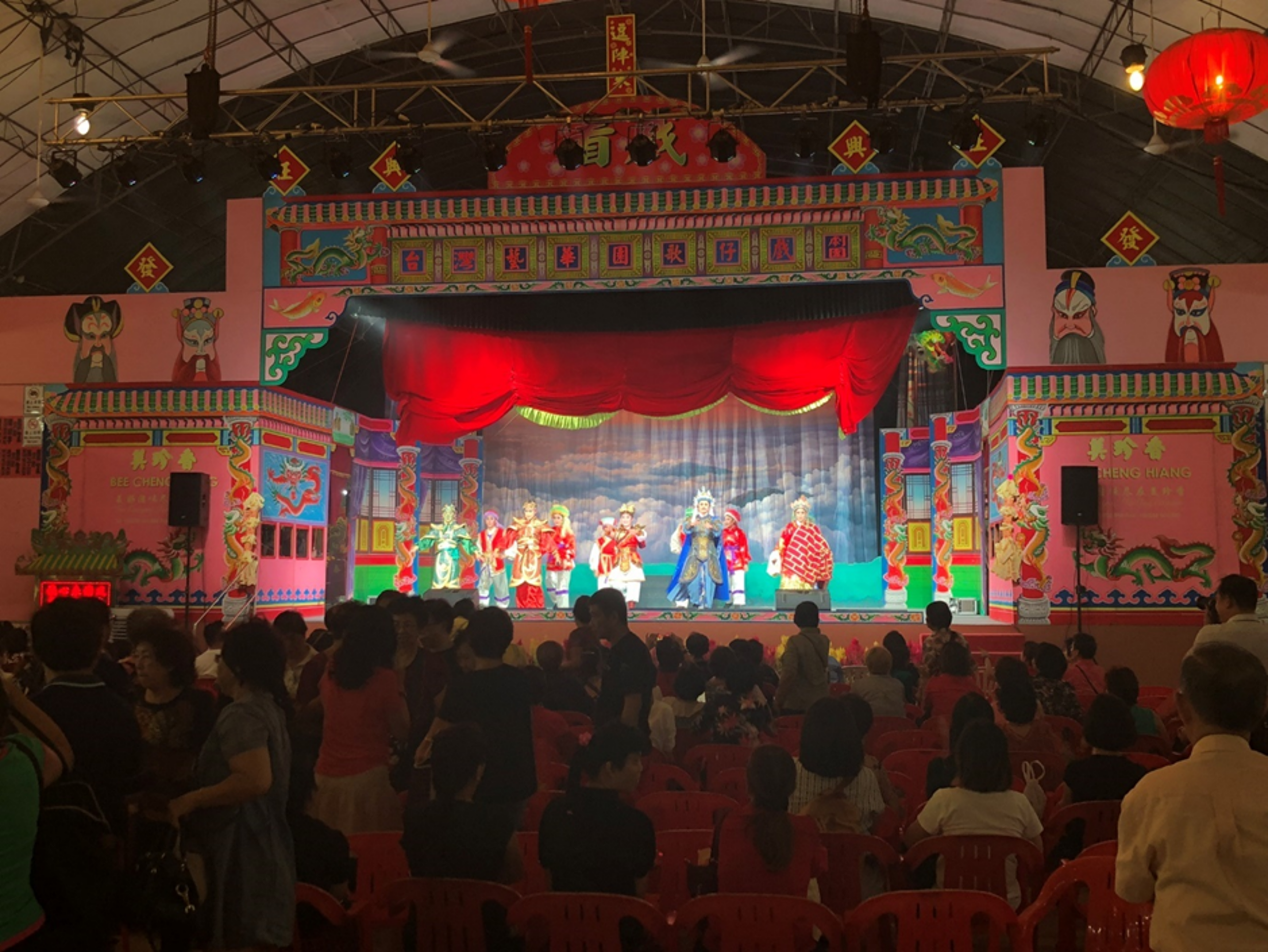
Reproducing images of theatres of the past in this context, I recall Lee Tong Soon’s conclusion to his study of Chinese Street Opera in Singapore. In the last chapter of the book, he describes the process of amateurising the Chinese street opera tradition, where in 1998 the Chinese Opera Society (Singapore), an amateur opera society that promotes Chinese opera in Singapore organised an event called Street Wayang Revisited. They invited Sing Yong Hoe Heng Teochew Wayang, a professional Chaozhou opera troupe to perform at the cultural festival in Bras Basah Park. Lee discusses the use of two photographs to show a shift in cultural paradigm. The first, a newspaper report on the festival had a caption, “The sights and sounds of Singapore past: Street wayang in full swing with a Teochew-opera presentation, staged by the Chinese Opera Society”. The second, a photograph published in Lianhe Zaobao on March 7, 1998, shows the above-mentioned Chaozhou troupe performing in the context of a choushenxi, a ritualistic performance for the gods with “only a scattering of twelve people or so in the audience”.[31] Lee’s comparison paints a picture of transition, as fewer professional troupes now operate and perform during religious festivals and birthdays of deities. But they are still there, such as when I took this picture (Figure 20) the year before COVID struck, the occasion being the birthday of the Jade Emperor, but the troupes of the old have given way to Taiwanese gezai troupes that visited Singapore often to perform during important festivals at Lorong Koo Chye Sheng Hong Temple.
Gibson-Hill’s photographs prompted a conscious effort to locate where he observed these temporary stages. They were likely to be next to or even within the courtyard of temples, or within Chinatown. That escalated to pinning down where the wayang stages were in the past and over a longer period. By using the Google Map interface, Hedren Sum, Kyueun Kim and I attempted to identify both outdoor and indoor stages, most of which were in downtown Singapore and near the Singapore River (See the map below).[32] These performances were put up by both touring troupes from the southern provinces of China, troupes which were already active across the Malay peninsula and North Borneo, and troupes that consisted of performers who had migrated to Singapore at the height of Singapore’s position as an important centre for Chinese opera in the 1890s to 1920s. Though the work in mapping both disappeared stages and demolished theatres is still in progress, our map already crystallises the sense of disappearance as most of these venues no longer exist, or have been transformed or repurposed.
3
Theatre and Photography
What does it mean to call this piece of writing a photowayang?
In one sense, it is to allude to the cross-pollination of wayang forms in the region and how Chinese street theatre has come be known as wayang. I am also reminded of wayang potehi, a popular form of glove puppet theatre which comes from the Fujian province and arrived on the Indonesian island of Java in the 18th century.
In another sense, it is also to evoke the spiritual significance of wayang. According to Henry Lisbijanto, “Wayang comes from the word Ma Hyang which means to go to the spiritual spirit, god or the Supreme God”.[33] Wa, the prefix to Wayang, means always moving, not fixed, or vaguely gradually becomes pertunjukan bayang-bayang (a shadow show).[34] Muhtar Sofwan Hidayat, Robingun Suyud El Syam and Mahmudi cite another source where, “wayang is an extension of the Wayahe words Sembahyang (time to pray)”.[35] The etymology of Wayang suggests movement as well as a call to communicate with the spiritual, which is what I wish to evoke with the above photographs.
To call this a photowayang is to combine photography with theatre, to explore the intersection of photography with play. It is also to recognise that, as with wayang, shadows can lead to imagination and conjuration by playing with the photographic remains. When I first encountered these photographs, I was filled with fascination as I discovered a Singapore I did not know about; I reconnected with my childhood memories of going to the temple and watching wayang. I am also fascinated by the theatres that people saw and heard; and the spaces they traversed, now captured as still images.
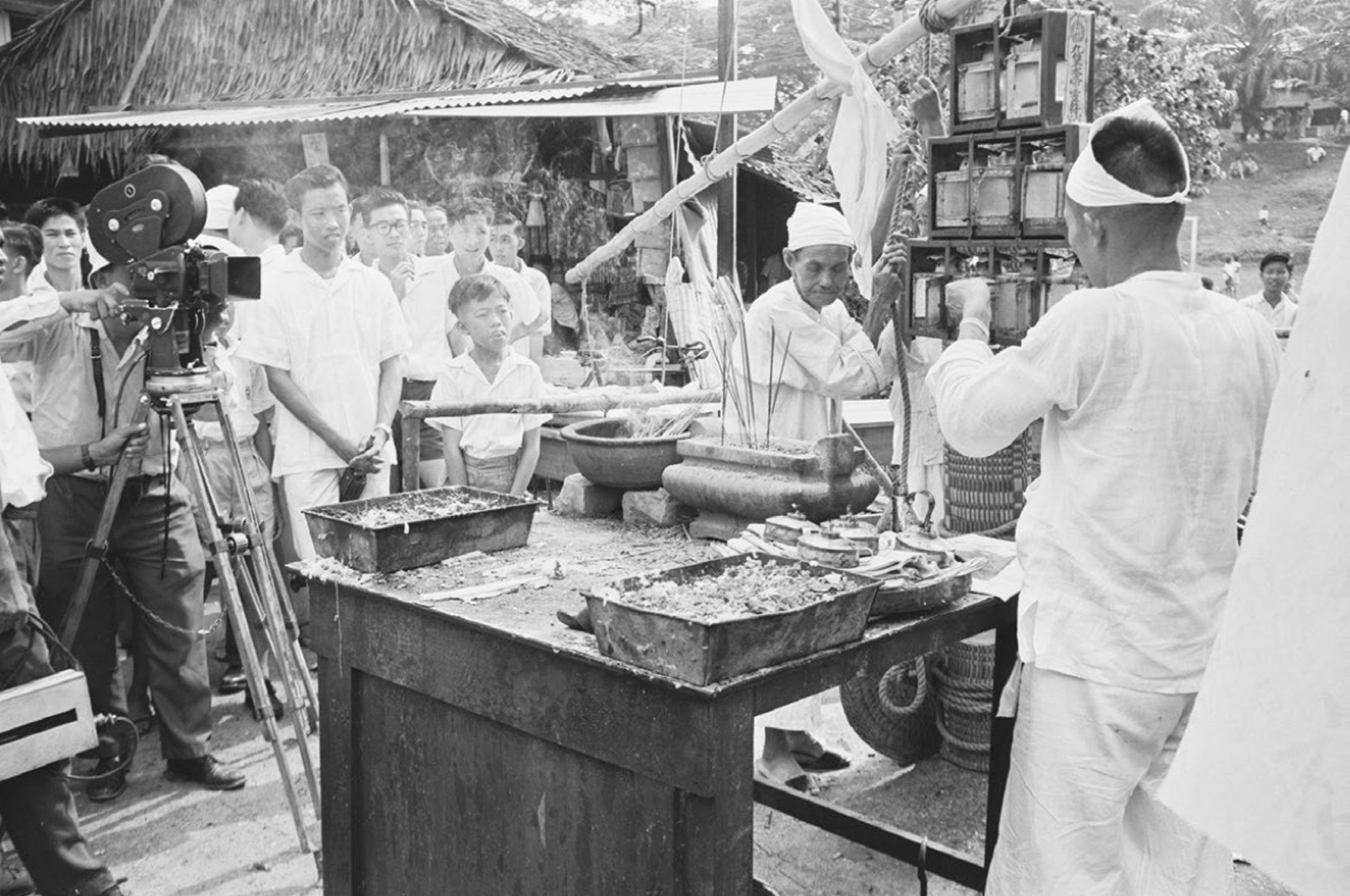
“A photograph attests to an interruption of chronological time, of life. The observation of a photograph takes us out of our own present, back into the moment of interruption—in this case …”[36] the streets, theatres, and liminal landscapes of 1940s to 1960s Singapore.
Theatre can be understood as a medium (of expression), or a representational medium. But it can also resist recording, its ephemeral nature ensuring that no one performance is the same and each recording of it is merely one iteration of many instances of a performance troupe’s repertoire.
Similar to photography, theatre is not a single medium. It refers to a range of practices and institutional spaces that give the context in which the meaning and the status of a particular photograph or performance can be interpreted.[37]
What does it mean to combine theatre and photography, and to “consider an exchange of ideas between photography and theatre by asking what we can learn from their close association”?[38]
Going beyond the distinction between photographs of theatres as documentation and staged photographs, I am interested in the movement and crossing between theatre and photography. For Anderson and Leister, this movement is called translation:
[W]e are interested in acts of translation between different media, translating from event into image, remediating from the position of photography into theatre, and back into former or different media states, as practices of rewriting their intermedial and interdisciplinary aspects.[39]
For me, the combination suggests an element of play, when I piece together a sequence of photographs with an audience in mind. A play suggests its future use and its future audience. But I would also like to emphasise that this mode of play compels you to imagine the movement in between photographs, that is, the theatricality that gathers people, gods, and objects and make them move; the theatricality that moves in the present and in the presence of others. Instead of emphasising the ocular and visual sense, theatre draws on more than one’s eyes to make the image speak.
‘The necessary condition for an image is sight,’ Janouch told Kafka; and Kafka smiled and replied: ‘We photograph things in order to drive them out of our minds. My stories are a way of shutting my eyes.’ The photograph must be silent (there are blustering photographs, and I don’t like them): this is not a question of discretion, but of music. Absolute subjectivity is achieved only in a state, an effort, of silence (shutting your eyes is to make the image speak in silence).[40]
A photographic image ceases to be static but conveys and projects movement, sounds, rhythms, and sensations that must be filled in by the viewer, however impossible that might be. Perhaps, I could also suggest that you, the reader, listen to a recording of the music that was heard on the Teochew wayang stage in the 1920s.
Play audio recording, “八仙贺寿 ( 其一 ) Ba Xian He Shou (Part 1)”
The audio recording captures a call to go to a (celestial) banquet, possibly the opening of Eight Immortals Birthday Greetings, performed by 老赛桃源 (Lao Sai Tao Yuan or Lau Sai Thor Guan in Teochew) in the 1920s. While this is a performance that is still staged today, the recording is also distinctively a remnant of the past. The crackling sound reminds us that this is ultimately a sound recording.
This photowayang imagines a historiography that includes a series of speculative scenarios informed by the historical archive, which in turn can narrate possible networks and compositions that constitute an archipelago of performance-making and travelling. From image to text, and to sound, I invite you to return to the scenarios and weave in your own discoveries and trajectories, bearing in mind to include the accounts of non-human actors and technologies. Instead of a linear narrative, this photowayang is also a way to highlight my practice of archiving loss and disappearance, as well as the gaps and lacunae; where memory fails or when I have to make sense of the various performance remains (to use Rebecca Schneider’s term). If there are any gaps here, I welcome you to fill them in, and perhaps this photowayang can be reiterated in another form, at another time, by another storyteller.
Notes
[1] “Tong qing cha yuan” [Tong qing teahouse], Shen Bao 15 December, 1897. My translation.
[2] Hede Gong, “京剧舞台美术”, 《中国大百科全书》, Beijing: Encyclopedia of China Publishing House. Accessed 2 June, 2025, https://www.zgbk.com/ecph/words?SiteID=1&ID=325007&Type=bkztb&SubID=161
[3] Weihong Bao, “Picture, Shadow, Play: Ontology, Archaeology, Ecology,” in The Oxford Handbook of Silent Film, eds. Rob King and Charlie Keil (New York: Oxford University Press, 2024), 170.
[4] “THE QUEEN’S JUBILEE IN THE FAR EAST”, The Illustrated London News, 20 August, 1887, 216.
[5] Megan Evans, “Chinese Xiqu Performance and Moving-Image Media,” Theatre Research International 34, no. 1 (2009): 21–36. https://doi-org.libproxy1.nus.edu.sg/10.1017/S0307883308004215.
[6] Xu Peng, “Hearing the Opera: ‘Teahouse Mimesis’ and the Aesthetics of Noise in Early Jingju Recordings, 1890s–1910s.” CHINOPERL 36, no. 1 (2017): 10. doi:10.1080/01937774.2017.1337693.10.
[7] “EDISON’S KINETOSCOPE”, The Straits Times, 13 July 1896, 2.
[8] “THE RIPOGRAPH”, The Straits Times, 13 May 1897, 2.
[9] Jonathan Sterne, The Audible Past: Cultural origins of sound reproduction (Durham: Duke University Press, 2003), 9.
[10] The Straits Times, 2 March 1892, 5. https://eresources.nlb.gov.sg/newspapers/digitised/article/straitstimes18920502-1.2.54.1
[11] For instance, Suryadi writes of a European entertainer named J. Calabressini travelling around Java with Edison’s phonograph; Suryadi, S. “The ‘talking machine’ comes to the Dutch East Indies: The arrival of Western media technology in Southeast Asia“, Bijdragen tot de taal-, land- en volkenkunde / Journal of the Humanities and Social Sciences of Southeast Asia 162, 2 (2008): 297. doi: https://doi-org.libproxy1.nus.edu.sg/10.1163/22134379-90003668
[12] Christopher Balme, “Interpreting the Pictorial Record: Theatre Iconography and the Referential Dilemma,” Theatre Research International 22, no. 3 (1997): 192. https://doi-org.libproxy1.nus.edu.sg/10.1017/S0307883300017004.
[13] Ibid.
[14] Ibid.
[15] Ibid.
[16] Leo Cabranes-Grant, From Scenarios to Networks: Performing the Intercultural Colonial Mexico (Illinois: Northwestern University Press), 25.
[17] Ibid.
[18] Permission is given solely to reproduce the photographs from the Carl Gibson-Hill photographic archive for this paper. Please do not copy, reproduce, or circulate these photographs.
[19] Quoted from the transcript of the oral history interview in BiblioAsia 15:4, available at https://biblioasia.nlb.gov.sg/vol-15/issue-4/jan-mar-2020/theatres-of-bangsw/. Listen to Reel 5 of “Hamid bin Ahmad (Haji) – Oral History Interviews – Record Details (Accession Number 000897)“, available at https://www.nas.gov.sg/archivesonline/oral_history_interviews/interview/000897.
[20] Matthew Issac Cohen, Komedie Stamboel: Popular Theater in Colonial Indonesia, 1891–1903 (Ohio: Ohio University Press, 2006), 198.
[21] I am uncertain about the term “kain gambarnya”, which can be literally translated as cloth picture. This suggests that the ‘painted backdrop’ was in fact a cloth, perhaps in the style of the embroidered cloth shown in Figure 3.
[21] Straits-Chinese Herald, or Surat Khabar Peranakan, 21 February 1894; Matthew Issac Cohen’s translation, cited in Cohen, 199.
[22] Ibid.
[23] Matthew Issac Cohen, 231.
[24] Ibid.
[25] Nadi Tofighian, “From Bombay to Singapore: Parsi Theatre Companies and Early Film Exhibitions,” Early Popular Visual Culture 23, no. 1–2 (2025): 131.
[26] 《叻报》, 1 June, 1920.
[27] “20,000 On Pilgrimage To Magic Island”, Sunday Tribune (Singapore), 29 September 1946, Page 1. https://eresources.nlb.gov.sg/newspapers/digitised/article/sundaytribune19460929-1.2.10.
[28] See Kenneth Dean, “Ritual Revolutions: Temple and Trust Networks Linking Putian to Southeast Asia,” in Encounters: An International Journal for the Study of Culture and Society Special Issue, ed. Peter van der Veer (Abu Dhabi and Dubai: Zayed University, 2011), 17–42; and Kenneth Dean, “Renewed flows of ritual knowledge and ritual affect within transnational networks: A case study of three ritual-events of the Xinghua (Henghwa) communities in Singapore,” in Asian Migrants and Religious Experiences, eds. Brenda Yeoh and Bernardo Brown (Amsterdam: Amsterdam University Press, 2018), 71–100.
[29] Kenneth Dean, “One ocean one temple: Alternative Chinese temple networks in Southeast Asia,” Global Networks 23 (2023): 634;638. https://doi-org.libproxy1.nus.edu.sg/10.1111/glob.12391.
[30]. Ibid., 641.
[31] Tong Soon Lee, Chinese Street Opera in Singapore (Champaign: University of Illinois Press, 2009), 159–160.
[32] This is a project to map the theatre spaces in Singapore (from 1835 to 1975), supported by the Social Science and Humanities Research Fellowship (MOE2022-SSHR-004).
[33] Herry Lisbijanto, Wayang (Yogyakarta: Graha Ilmu, 2013); quoted in Kenfitria Wijayanti and Djoko Sulaksono, “Wayang Existence in The Islamization for Traditional Javanese People” el Harakah: Jurnal Budaya Islam 21, no. 1 (2019): 128.
[34] Ibid.
[35] Muhtar Sofwan Hidayat, Robingun Suyud El Syam and Mahmudi, “The Symbolic Meaning of Wayang in Javanese Community Transmission and Islamic Education Sufism,” Edupedia: Jurnal Studi Pendidikan dan Pedagogi Islam 8, no. 2 (2024): 110.
[36] Jan Kuehne, “Backstage of the Eye,” Performance Research 26, no. 5 (2021): 88.
[37] Joel Anderson and Wiebke Leister, “The Theatre of Photography: Dialogues,” Photography & Culture 11, no. 2 (2018): 124.
[38] Ibid., 122.
[39] Ibid., 124.
[40] Barthes, Roland. (1981). Camera Lucida. Reflections on photography (New York, NY: Hill and Wang, 1981): 53, 55.