Hedren Wai Yuan Sum

Routes of Reform: Tracing Zhen Tian Sheng’s 1909 Nanyang Tour

On 8 March 1909, wrote to Chuang Yin’an 莊銀安, the leader of the Yangon Branch of the Tongmenghui 同门会 (Chinese […]

1911-1912 Xinhai Revolution Archipelagic Agents Chinese Opera or Wayang Reformist Theatre

On 8 March 1909,

Sun Yat-sen 孫中山
Sun Yat-sen
Related Tags:
Support
wrote to Chuang Yin’an 莊銀安, the leader of the Yangon Branch of the Tongmenghui 同门会 (Chinese Revolutionary Alliance). The letter brings together political correspondence, route information, and the theatrical movement of the Cantonese troupe
Zhen Tian Sheng 振天声
Zhen Tian Sheng Troupe (中國振天聲社)
Related Tags:
Troupe
  across Nanyang.

Sun’s letter situates the troupe within the circuits of Tongmenghui communication and the shifting geography of revolutionary support in Southeast Asia. Addressing Chuang as “Jifu renxiong” 吉甫仁兄, Sun wrote that Zhen Tian Sheng had only recently arrived in Nanyang and was already facing obstruction. The “Baodang” 保党, a term that may be understood here as referring to royalist or pro-Qing circles, had spread rumours and sought to undermine the troupe. Before the tour is mapped as an itinerary, it appears as a contested political event.
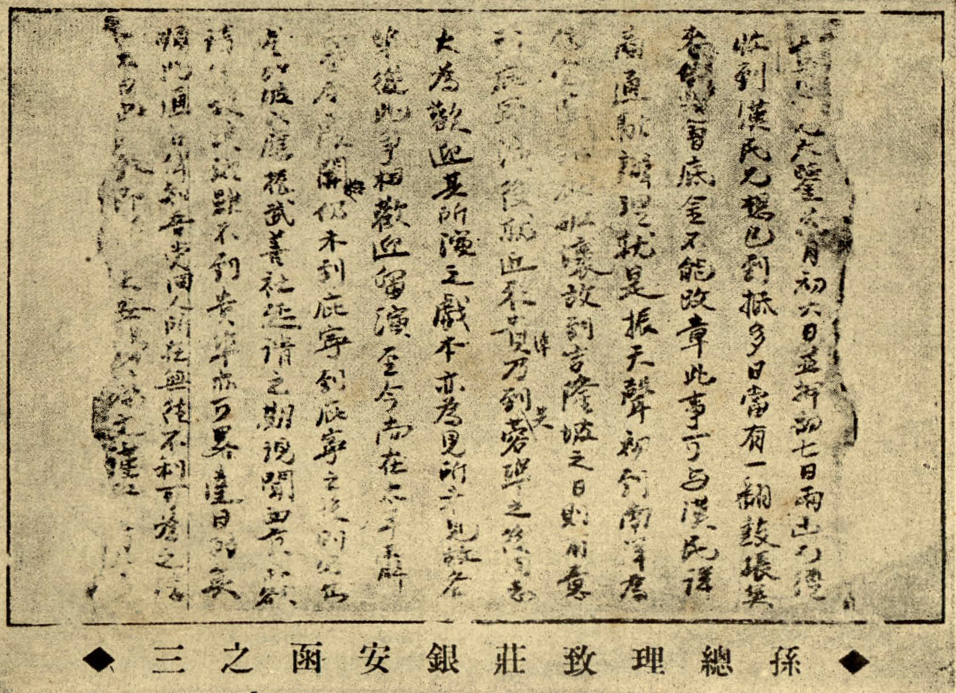
Letter by Sun Yat-Sen to Ch’ng Yeen Aun (莊銀安 Chuang Yin’an) highlighting the legs of the Nanyang Tour of Zhen Tian Sheng. In Zhang Yongfu, 南洋与创立民国 Nan yang yu chuan li min guo, 87. 上海: 上海中华書局, 1933.

吉甫仁兄大鉴:花月初六日并押初七日两函,已经收到。汉民兄想已到抵多日,当有一翻鼓振矣。来信云会底金不能改章,此事可与汉民详商,通融办理就是。振天声初到南洋,为保堂造谣,欲破坏。故到吉隆坡之日,则有意到庇宁演后就近来贵埠。乃到芙蓉埠之后,同志大为欢迎,其所演之戏本亦为见所未见:故各埠从此争相欢迎,留演至今,尚在太平、霹雳各处开台,仍未到庇宁。到庇宁之后,则必出星加坡,以应振武善社延请之期,现闻西贡亦欲请往。故该班虽不到贵埠,亦可略达目的矣。顺此通告,俾知吾党同人所在无往不利,可为之浮一大白也。此致,即候大安

The passage unfolds through place names, delays, invitations, and unexpected enthusiasm. Zhen Tian Sheng had intended, after reaching Kuala Lumpur, to perform in Penang before travelling on to Chuang’s branch. Its reception in Seremban altered the rhythm of the tour. There, Sun noted, comrades warmly welcomed the troupe, and its plays were described as “unlike anything seen before” 见所未见. From that point, different towns across Malaya competed to host it. The troupe remained performing in Taiping and other places in Perak, had not yet reached Penang, and was expected to proceed to Singapore after Penang in response to an invitation from the
Singapore Anti-opium Society (Zhenwu Shanshe 振武善社)
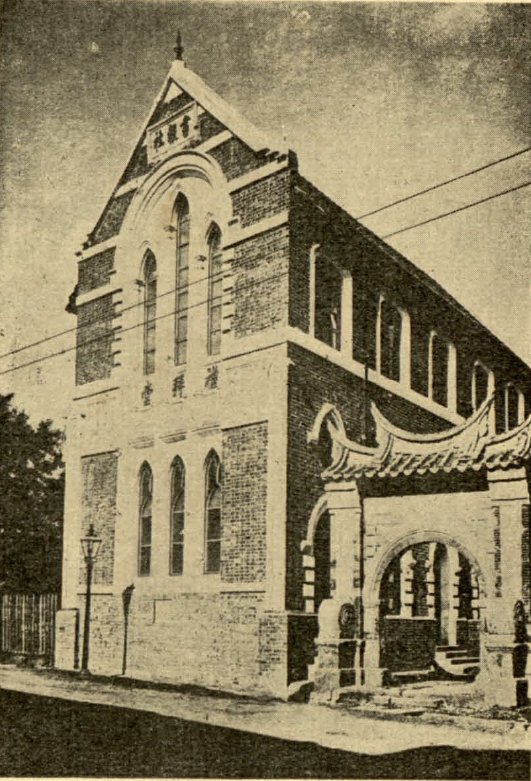
Singapore Anti-Opium Society (振武善社)
Related Tags:
Support
. Sun also noted that Saigon had expressed interest in inviting the troupe.

The significance of this letter for performance history lies in the way it registers a Cantonese troupe’s tour within revolutionary communication. Zhen Tian Sheng’s performances are not mentioned as ordinary entertainment, nor are they preserved here through a theatre programme or newspaper advertisement. They appear in a letter from one revolutionary leader to another, as evidence of how theatre could move people, gather comrades, draw invitations, and advance political purpose across Nanyang. The troupe’s itinerary is therefore inseparable from the Tongmenghui networks that observed, supported, and circulated its work. To understand why Zhen Tian Sheng mattered, we need to turn from the route itself to the political uses of theatre: how a Cantonese troupe became a platform through which reformist and revolutionary ideas were staged, heard, and carried across overseas Chinese communities.

Zhen Tian Sheng and the Political Uses of Theatre

Zhen Tian Sheng was a Cantonese theatre troupe active in the final years of the Qing dynasty and associated with reformist and revolutionary currents in late Qing performance culture. It belonged to a wider movement that used popular performance to address social reform, national crisis, anti-opium advocacy, and revolutionary change.

The troupe is frequently associated with the phenomenon of zhishi ban 志士班, or “patriotic activists’ troupes.” These politically active Cantonese groups adapted traditional operatic forms for modern public purposes. Through speech, song, gestures, costumes, plot, and collective audience participation, they conveyed reformist and revolutionary ideas in an engaging and visible manner. Theatre served as a platform where political urgency could be embodied and communicated to large audiences.

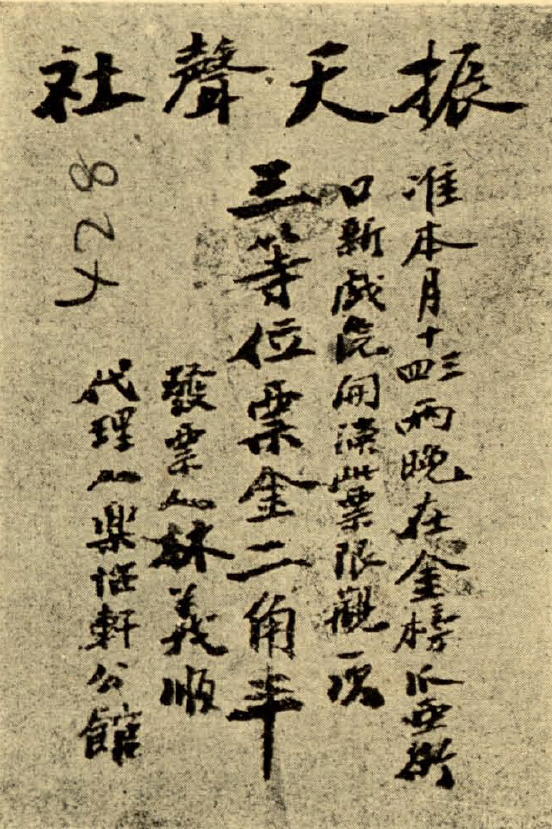
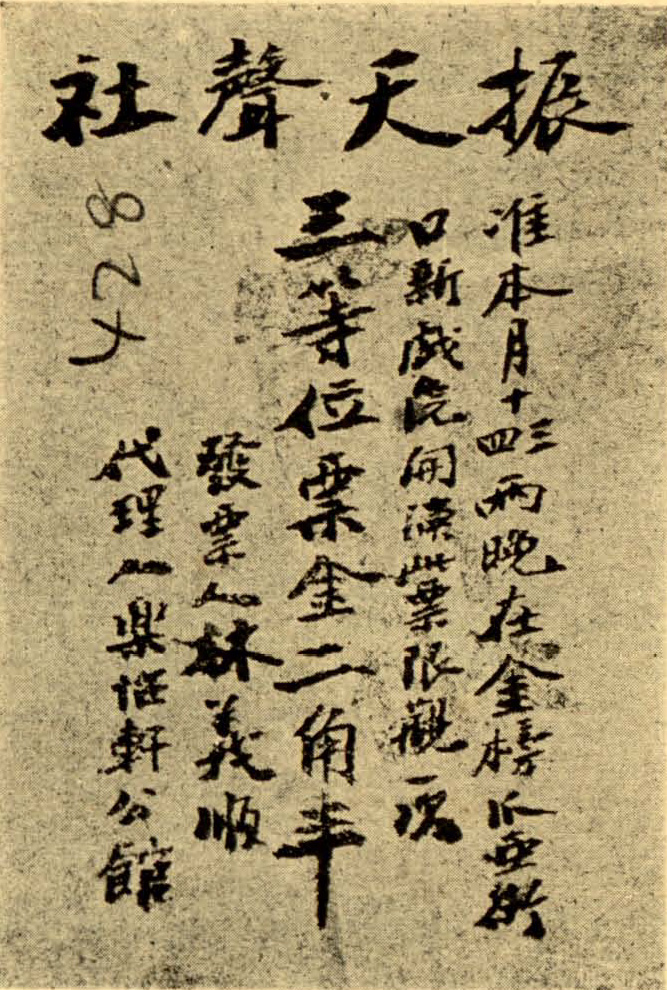
The political intent behind Zhen Tian Sheng is explicitly documented in accounts linked to Tongmenghui members. A key piece of evidence is a performance ticket preserved by Tan Chor Nam 陳楚楠, a founding member of the Tongmenghui and president of its Singapore branch. This ticket was later reproduced in Nanyang yu chuangli Minguo 南洋與創立民國, published by Zhang Yongfu 张永福, vice-president of the Tongmenghui Singapore branch (Zhang 1933, 74). The note accompanying the ticket states that Zhen Tian Sheng was organized for party propaganda: “振天聲劇社為本黨利用宣傳所組織”—“Zhen Tian Sheng Theatre Society was organized for use by our party in propaganda.” In Tongmenghui’s memory, Zhen Tian Sheng functions as a tool for publicity, persuasion, and mobilization.

Feng Ziyou 馮自由, a founding member of the Tongmenghui who later led its Hong Kong branch, provides a more detailed account in Geming yishi 革命逸史 (Feng 1940, 242):

淸制國喪期內禁止演劇,該班乃藉賑災募款爲名,赴南洋諸埠遊歷演唱,所編諸戲本,名爲勸人禁煙禁賭,實則暗中宣傳革命,於南洋華僑民智之啓導,厥功非鮮。自乙已以迄己酉之四五年間,經報界之熱心鼓吹,及志士之現身說法,其影響所及,遂伙在舊式戲班之諸伶,亦漸有排演愛國新劇之傾向。

Feng’s account explains the mechanism of political theatre. During the Qing state mourning period, when theatrical performances were prohibited, Zhen Tian Sheng travelled through the ports of Nanyang under the name of disaster-relief fundraising. Feng writes that the tour served two objectives: first, to advocate for disaster victims and raise relief funds; second, to covertly promote revolution among overseas Chinese communities (Feng 1940, 245). Its plays were presented as exhortations against opium and gambling, while secretly propagating revolution. Feng credits these performances, together with newspaper advocacy and the personal efforts of committed activists, with awakening political consciousness among overseas Chinese in Nanyang and influencing older-style theatre performers to stage patriotic new plays.

Read together, Tan Chor Nam’s ticket note and Feng Ziyou’s account show why Sun Yat-sen’s 8 March 1909 letter matters for performance history. The letter’s references to welcome, obstruction, invitation, and route belong to a larger strategy in which theatre served as public gathering, charitable performance, moral instruction, and revolutionary communication. Zhen Tian Sheng travelled as a Cantonese troupe, but its performances moved through Tongmenghui networks as instruments of persuasion and mobilisation.

The Tour in Motion

Sun Yat-sen’s letter gives the first broad indication of Zhen Tian Sheng’s Nanyang route. It names a movement through Kuala Lumpur, Seremban, Taiping, Perak, Penang, Singapore, and the possible extension to Saigon, while also suggesting that the tour was being reshaped by local reception. The newspaper record allows this outline to be reconstructed in greater detail. For instance, Chinese and English newspapers documented arrivals and departures, theatre bookings, play titles, host organisations, ticket receipts, financial arrangements, rumours, rebuttals, and press debates. The interactive route map begins with the route indicated in Sun’s letter and builds outward through newspaper documentation.

Piecing the tour together requires moving across different kinds of newspaper traces. No single report gives the whole itinerary. A notice may announce an intended performance; a later report may confirm arrival; an advertisement may identify the play, venue, date, and host; a financial summary may show that the performance took place and generated proceeds; another article may record a dispute over reception, accounting, or remittance. The route is therefore reconstructed by comparing fragments, aligning dates, resolving variant place names and transliterations, and distinguishing between planned, confirmed, delayed, contested, and retrospective events.

The reconstructed route shows that the tour was adjusted through invitation, reception, obstruction, and opportunity. Performances were extended where audiences responded strongly; new hosts stepped forward when earlier engagements generated momentum; local associations took responsibility for accommodation, ticketing, publicity, and accounts. Transport by steamship and train connected the stops, but the tour itself was held together by social and political infrastructures: anti-opium societies, Chinese chambers, charitable bodies, guilds, newspapers, merchants, and Tongmenghui-linked supporters.

Kuala Lumpur offers a clear example of how one stop is assembled from several traces. Notices and reports record arrival arrangements, the involvement of the Kuala Lumpur Chinese Chamber of Commerce 吉隆商會 and the Kuala Lumpur Anti-Opium Association (Zhenwu Society 吉隆振武社), performances of plays such as Meng hou zhong 夢後鐘 and  Heiyu honglian 黑獄紅蓮, ticket receipts, special seats, and questions over financial control. Taken together, these traces show Kuala Lumpur as a performance stop, a fundraising site, a logistical arrangement, and an early site of suspicion.

The same method applies across the Perak circuit. Ipoh, Kampar, Gopeng, and Taiping appear through railway movements, meeting reports, theatre arrangements, hospitality records, and financial summaries. One report records a local organisation preparing to receive the troupe; another records performances and collections; another discusses expenses and remittances. The route becomes visible as a sequence of relationships among towns, hosts, donors, transport, performances, and accounts.

Penang and Singapore show why multilingual newspapers matter. In Penang, Chinese newspapers provide advertisements, synopses, performance reports, and accounts of local reception, while English newspapers report fixtures, venues, charity performances, and the troupe’s wider reputation. In Singapore, Chinese reports document
Lai Chun Yuen 梨春園
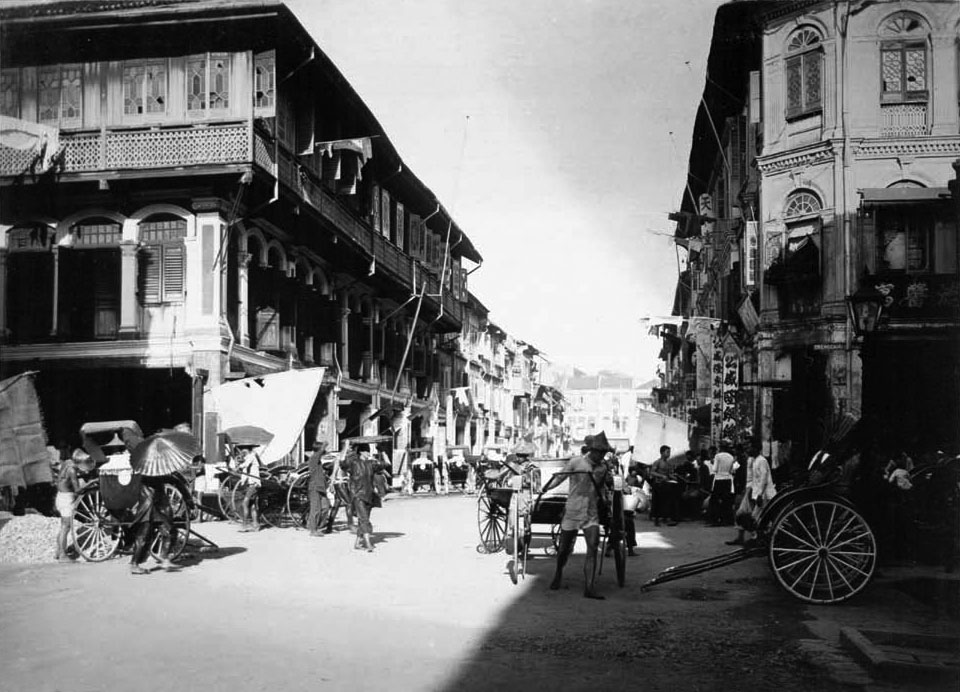
Lai Chun Yuen (梨春园)
Related Tags:
Venue
, Singapore Anti-opium Society, volunteer committees, donor lists, and auctioned objects, while English newspapers refer to the Smith Street theatre, Theatre Royal, crowded audiences, receipts, and elite amateur performers. The same tour stop has to be reconstructed across languages, scripts, naming conventions, and journalistic forms.
The newspapers, however, show how that ambiguity had to be managed in real time. Royalist and constitutionalist critics sought to expose the charitable frame as a revolutionary disguise. Revolutionary-leaning newspapers, especially Chong Shing Yit Pao 中興日報, responded by defending the troupe’s legitimacy as a disaster-relief and public-welfare effort. These rebuttals should not be read only as simple denials. They were also acts of reputation management. They reassured donors, protected local hosts, defended the credibility of the
Hong Kong Ba Yi Office 香港八邑公所

Hong Kong Ba Yi Office (香港八邑公所)
Related Tags:
Support
, and helped keep the route open as the troupe moved from one town to another.

The route map is therefore not an illustration added after the historical work has been done. It is part of the historical argument. It shows how performance history can be reconstructed from distributed traces that were never preserved as a single archival object. A shipping notice, an advertisement, a performance report, a donor list, a financial summary, and a polemical article each capture only part of the tour. When brought into relation, they make visible the circulatory conditions through which performance travelled across Nanyang.

The newspaper record also shows that the tour was contested as it moved. This contestation is especially revealing because later revolutionary accounts were quite direct about the troupe’s political purpose. Feng Ziyou and Zhang Yongfu both place Zhen Tian Sheng within Tongmenghui-linked revolutionary work, presenting the tour as a way to promote revolutionary efforts under the charitable cover of disaster-relief fundraising. In retrospective revolutionary memory, the ambiguity of the tour was part of its strategy.

The press timeline follows this contestation as a sequence of claims, suspicions, clarifications, rebuttals, and renewed attacks. Early reports already show concerns over authorisation and financial control. The Hong Kong Ba Yi Office and its representatives had to clarify that the troupe had been sent to raise funds for flood relief. In Kuala Lumpur and Perak, reports record questions over who should manage proceeds, how expenses should be deducted, and whether the remaining funds would be remitted properly. These were practical matters, but they also became political: doubts over accounting could be used to undermine the legitimacy of the tour.

By late February and March, the contestation became more explicit. Royalist or constitutionalist critics questioned the charitable mission and accused the troupe of revolutionary intent. Revolutionary-leaning reports defended Zhen Tian Sheng against rumours and framed the troupe as engaged in public welfare. The clash between The Union Times (Zong hui xin bao 總匯新報) and Chong Shing Yit Pao made this dispute visible in print. The irony is important: what later revolutionary accounts presented as a strategic use of charity for revolutionary ends had, in the moment of performance, to be protected as credible public welfare. The tour depended on that credibility for audiences, hosts, ticket buyers, donors, and onward invitations.

The contestation, therefore, reveals the double life of the tour. Within revolutionary memory, Zhen Tian Sheng appears as a vehicle for political mobilisation. Within the newspaper debates of 1909, it had to appear as a legitimate charitable enterprise. Royalist criticism tried to collapse these two registers by exposing the revolutionary purpose behind the charity. Revolutionary rebuttals tried to keep them apart long enough for the tour to continue. This tension is central to understanding how performance, print, and politics worked together across Nanyang.

Tracing the tour produces more than a route. It also reveals a field of affiliations. As newspaper fragments are linked to places, performances, hosts, donors, notices, rebuttals, and later recollections, Zhen Tian Sheng begins to appear as a node within overlapping infrastructures of charity, reform, anti-opium activism, revolutionary mobilisation, commerce, and print. This is one of the main analytical gains of modelling the tour through APHon: dispersed traces can be reorganised into relations.

Click a node to show its central-path connection, focus network, and relationships.

Knowledge graph of Zhen Tian Sheng 振天聲 and its 1909 Nanyang tour network. Created using the D3 JavaScript Library (Force-directed Graph), this interactive visualisation maps the web of relationships centred on the Cantonese reformist troupe Zhen Tian Sheng 振天聲. It brings together persons, organisations, performance repertoire, venues, places, sources, routes, and related events associated with the troupe’s 1909 tour through Nanyang. Structured through APHon, a domain ontology for modelling archipelagic performance histories, the graph makes visible how the troupe’s tour was shaped by both direct connections, such as performances, invitations, venues, and supporting organisations, and mediated connections, such as revolutionary networks, newspaper reports, commemorative sources, and later historical accounts. Users can filter node categories, follow direct and indirect paths from Zhen Tian Sheng, and examine how performance, philanthropy, anti-opium advocacy, diasporic association, and revolutionary politics intersected across the tour network.

The affiliation network extends the route analysis by showing how relations emerge from fragments. An advertisement may connect a performance to a venue, host organisation, play title, and date. A financial report may connect a town to ticket receipts, expenses, and remittance to the Hong Kong Ba Yi Office. A rebuttal may connect a newspaper to a rumour, a political position, and a particular tour stop. A later recollection may connect the tour to Tongmenghui memory. None of these traces gives the whole structure by itself. Together, they show how Zhen Tian Sheng’s tour moved through multiple forms of affiliation at once.

The Hong Kong Ba Yi Office appears repeatedly as the charitable authority that sent or authorised the troupe, received remittances, and issued clarifications when rumours circulated. The Singapore Anti-opium Society appears as a host that arranged performances, accommodation, volunteer duties, and public notices. Perak Le Shan Tang shows how a local charitable body could receive the troupe, organise meetings, prepare accommodation, and manage the practical conditions of performance. Newspapers occupy another kind of position: they did not host performances, but they shaped the public meaning of the tour by defending, questioning, publicising, or contesting it.

These affiliations were politically charged. Links to the Hong Kong Ba Yi Office, anti-opium societies, Tongmenghui figures, and revolutionary newspapers helped legitimise the troupe’s charitable mission among supporters. The same links made it vulnerable to royalist and constitutionalist criticism. Opponents could point to these affiliations as evidence that disaster-relief fundraising concealed revolutionary propaganda. The press debate was therefore part of the network itself: a set of claims and rebuttals through which different publics tried to define what Zhen Tian Sheng was, whom it served, and what its performances meant.

The evidence remains uneven. Some relations are directly documented, such as an organisation named in an advertisement or a newspaper report recording a performance. Others are inferred from repeated association, later recollection, or contested accounts. The tour becomes visible through these uneven traces, but its reconstruction must retain their unevenness.

Together, the route map, press timeline, and affiliation network allow the section to hold detail without overloading the prose. The route map shows how the tour moved; the timeline shows how its meaning was disputed; the network shows what kinds of relations become visible when scattered traces are linked. The larger argument is that Zhen Tian Sheng’s 1909 tour survives not as a complete itinerary, but as a route of performance, publicity, support, and dispute assembled from fragments.

An Uncertain Poster

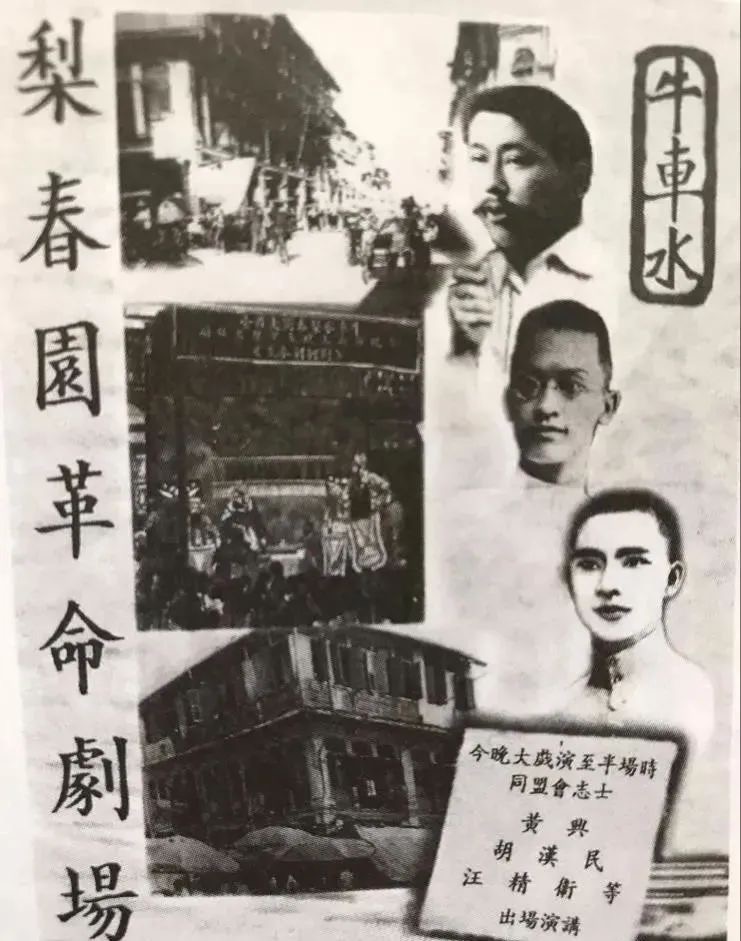
A poster associated with Lai Chun Yuen appears, at first, to offer a striking visual trace of Zhen Tian Sheng’s revolutionary theatre in Singapore. Large vertical characters identify the venue as “梨春園革命劇場” — “Lai Chun Yuen Revolutionary Theatre” — while the upper-right inscription “牛車水” locates the scene in Kreta Ayer, Singapore’s Chinatown. The poster combines photographs of streets, buildings, and performance with portraits of revolutionary figures. Its most striking claim appears near the lower right: “今晚大戲演至半場時同盟會志士黃興、胡漢民、汪精衛等出場演講” — “After the first half of tonight’s wayang performance, Tongmenghui patriots Huang Xing, Hu Hanmin, Wang Jingwei and others will appear on stage to give speeches.” The poster therefore frames theatre as a space where performance and revolutionary address meet.

The poster raises questions because its source, date, and relationship to Zhen Tian Sheng remain uncertain. Yet the scene it appears to represent cannot be dismissed outright, since other accounts also associate the troupe with Sun Yat-sen, Tongmenghui networks, and revolutionary performance in Singapore. Its visual treatment, especially the montage of photographs, portraits, labels, and commemorative text, seems unlikely to belong to the early twentieth century. Its known publication context is modern: it appeared in Lianhe Zaobao 聯合早報 on 8 October 2001 in relation to a performance of Jing Ke ci Qin wang 荊軻刺秦王 staged at the original Lai Chun Yuen building on 24 November 2001. The accompanying account stated that in 1908 Zhen Tian Sheng performed Jing Ke at the Smith Street theatre, and that revolutionaries used the occasion to mobilise support for political reform. A follow-up reception article on 25 November 2001, and later writing by Lin Renyu 林仁余, repeated the association between Zhen Tian Sheng, Lai Chun Yuen, revolutionary speeches, and Sun Yat-sen’s circle (Lin 2011).

The difficulty is that these later accounts do not align neatly with the presently documented route. Chinese and English newspapers, including Chong Shing Yit Pao, The Union Times, Penang Sin Poe 檳城新報, and The Straits Times, report that Zhen Tian Sheng first arrived in Singapore from Hong Kong on 24 January 1909 aboard the SS Kam Sung 金生輪船. The troupe then moved through several Malayan cities and towns before returning to Singapore from Penang on 14 March 1909 by the SS Rotorua 洛搭拿船. This 1909 itinerary is also supported by later scholarship, such as Lin 2019 (289). By contrast, other accounts and scholarship place the troupe in Singapore in late 1908, shortly after the performance ban in China following the death of Emperor Guangxu (Lin 2017, 215; Yen 1995, 276; Yu 1994, 495; Zhang 2022, 89). The dates are close enough to make an earlier encounter possible, but current evidence does not confirm whether Zhen Tian Sheng visited Singapore before its documented 1909 tour.

The question of Sun Yat-sen’s engagement with the troupe is similarly plausible but unresolved. Scholarship by Lin 2011 and Wang and Yang 2022, as well as Feng Ziyou’s retrospective account, emphasise a meeting between Sun and Zhen Tian Sheng members at Wan Qing Yuan 晚晴園, where those who had not joined the Tongmenghui expressed their willingness to do so (Feng 1940, 245). This broadly matches Sun’s presence in Singapore during the period. Yet Feng does not provide an exact date, and no contemporaneous newspaper record has yet been found confirming that Sun or any of his comrades attended a Zhen Tian Sheng performance at Lai Chun Yuen in November 1908, or that the encounter unfolded in the way later accounts describe.

The repertoire claim raises another layer of uncertainty. Later accounts identify the supposed 1908 Lai Chun Yuen performance as Jing Ke, a thematically plausible attribution. The story of Jing Ke’s attempted assassination of the Qin king could readily be read through the revolutionary and nationalist idioms associated with Zhen Tian Sheng’s reformist theatre. Yet the presently documented 1909 newspaper record does not confirm that the troupe performed Jing Ke in Singapore in November 1908. The known repertoire from the 1909 tour includes politically charged plays such as Bolangsha ji Qin 博浪沙擊秦. The presence of Bolangsha ji Qin is suggestive, since it belongs to a similar anti-Qin historical imaginary. It raises the possibility that later references to Jing Ke preserve a related repertoire memory, or that different anti-Qin plays associated with revolutionary theatre were later conflated. At present, however, the specific attribution to Jing Ke remains tied to later memory and scholarship rather than to a contemporaneous performance notice.

The poster should therefore be read neither as false evidence nor as confirmed documentation. It is better understood as an uncertain representation: a later visual condensation of claims, memories, and associations around Zhen Tian Sheng’s revolutionary theatre. It may preserve a memory of an actual encounter between the troupe and revolutionary networks, but it cannot presently secure the date, venue, repertoire, speakers, or sequence of events it appears to represent.

Read alongside the newspaper route, the poster raises a different question: how did Zhen Tian Sheng come to be remembered as part of Singapore’s revolutionary landscape? The newspapers allow the 1909 tour to be followed through their reports of movements and performances. The poster gathers theatre, Tongmenghui figures, Lai Chun Yuen, Wan Qing Yuan, revolutionary speech, and later commemoration into a single image. One reconstructs circulation; the other reveals memory.

This distinction is important for Performing Archipelagos. Archipelagic performance histories often survive through traces that differ in date, function, proximity, and evidential force. The documented 1909 tour, the possible late-1908 encounter, Feng’s retrospective account, later scholarship, the uncertain Jing Ke attribution, and the modern publication context of the poster cannot be reduced to a single secure chronology. They have to be held together with their different degrees of certainty. The poster matters precisely because it shows how performance history is shaped not only by what can be firmly documented, but also by how later memory organises fragments into powerful representations.

Conclusion

Zhen Tian Sheng’s Nanyang tour shows how performance history can survive less as a stable event than as a set of relations among traces. A letter, a performance ticket, newspaper reports, polemical articles, later accounts, and an uncertain poster each preserve only part of the story. Their significance emerges when they are read together, but their differences cannot be smoothed into a single chronology.

By linking routes, performances, venues, organisations, sources, media, and degrees of uncertainty, it makes visible how a Cantonese troupe moved through infrastructures of theatre, charity, print, transport, and revolutionary politics. It also shows how later memory reshaped that movement into powerful images of revolutionary theatre.

Zhen Tian Sheng’s history therefore lies not only in what can be firmly documented, but in the relations between documentation, contestation, recollection, and representation. To model these relations is to treat uncertainty not as a failure of the archive, but as one of the conditions through which archipelagic performance histories become knowable.

References

Feng, Zhiyou. 1940. 革命逸史 Geming yishi [An anecdotal history of the Revolution ]. Vol. 2. 商務印書館.

Huang, Lu and Yang, Min. 2022. “From Local Ritual to Ethnic Identification: A Study on the Spread and Development of Cantonese Opera in Southeast Asia in the Early 20th Century.” Hundred Schools in Arts, 186 (3): 87-93.

Lin, Renyu. 2011. “Nanyang yingju zhong you geming jiyi” 南洋影劇中有革命記憶 [Revolutionary Memory in Nanyang Film and Drama]. In Bainian Xinhai: Nanyang Huimou百年辛亥: 南洋回眸 [Centenary of the Xinhai Revolution: Retrospective on Nanyang], edited by Zhou Zhaocheng, 214-221. World Scientific Publishing.

Lin, Zhiqiang. 2019. “Zhen Tian Sheng Nanyang Yiyan” 振天声南洋义演 [The Nanyang Charitable Performance of Zhen Tian Sheng]. In Youying Zhen Tian Sheng: Niucheshui bainian wenhua licheng 优影振天声: 牛车水百年文化历程 [A Century of Cultural Journey in Chinatown], edited by Huang Ziming, 287-294. Bafang Wenhua.

Yen, Ching-hwang. 1995. “Chinese Revolutionary Propaganda Organizations in Singapore and Malaya, 1906-1911”. In Community and Politics: The Chinese in Colonial Singapore. Times Academic Press.

Yu, Weixiong. “Xinhai geming shiqi Gang Ao diqu zhi xuanchuan ji yingxiang” 辛亥革命時期港澳地區之宣傳及影響 [Propaganda and its influence in the Hong Kong and Macao regions during the Xinhai Revolution period]. Nengren xuebao, no. 3 (August 1994): 483–504.

Zhang, Beiyu. 2022. “Cantonese opera troupes in Southeast Asia.” Asian Ethnology 81, no. 1/2 (2022): 83-106.

Zhang, Yongfu. 1933. Nan yang yu chuan li min guo 南洋与创立民国. Shanghai Zhonghua Shuju.

To Cite:
Sum, Hedren Wai Yuan. 2025. Routes of Reform: Tracing Zhen Tian Sheng’s 1909 Nanyang Tour. In Performing Archipelagos, edited by Kyueun Kim, Alvin Eng Hui Lim and Hedren Wai Yuan Sum. Singapore: National University of Singapore.
Scroll to Top