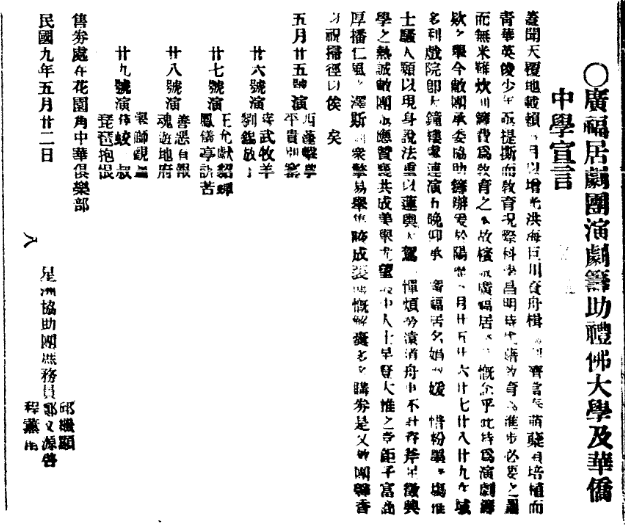
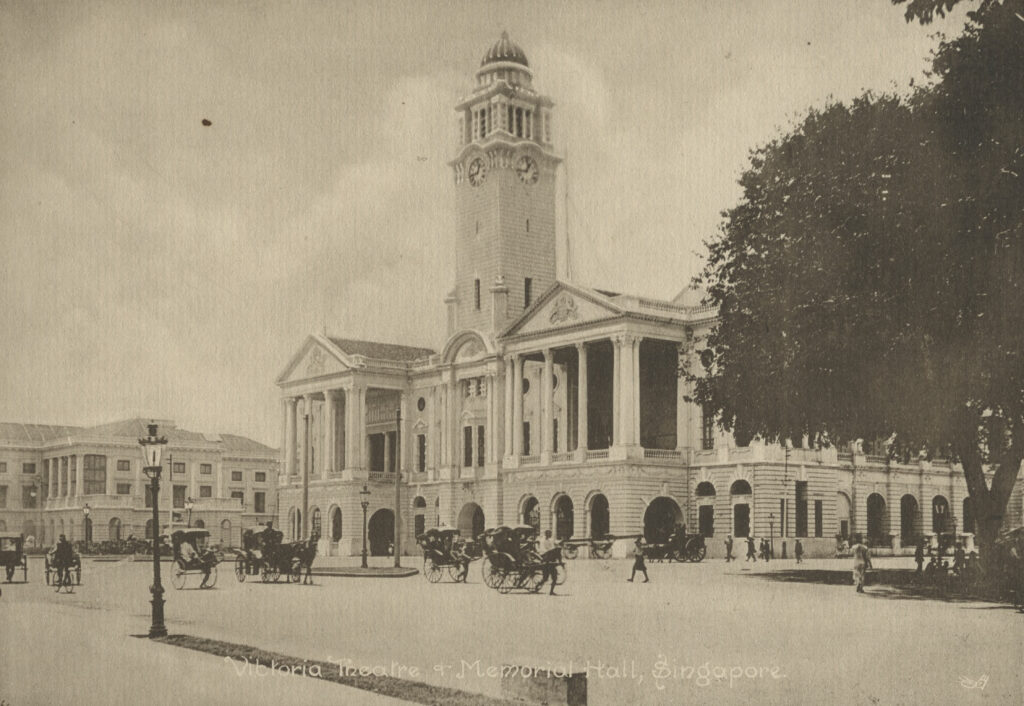
Li chun yuan; Lai Chun Yuen Teahouse Theatre; 牛车水戏院; Smith Street theatre-hall [The Straits Times, 27 March 1909]
About
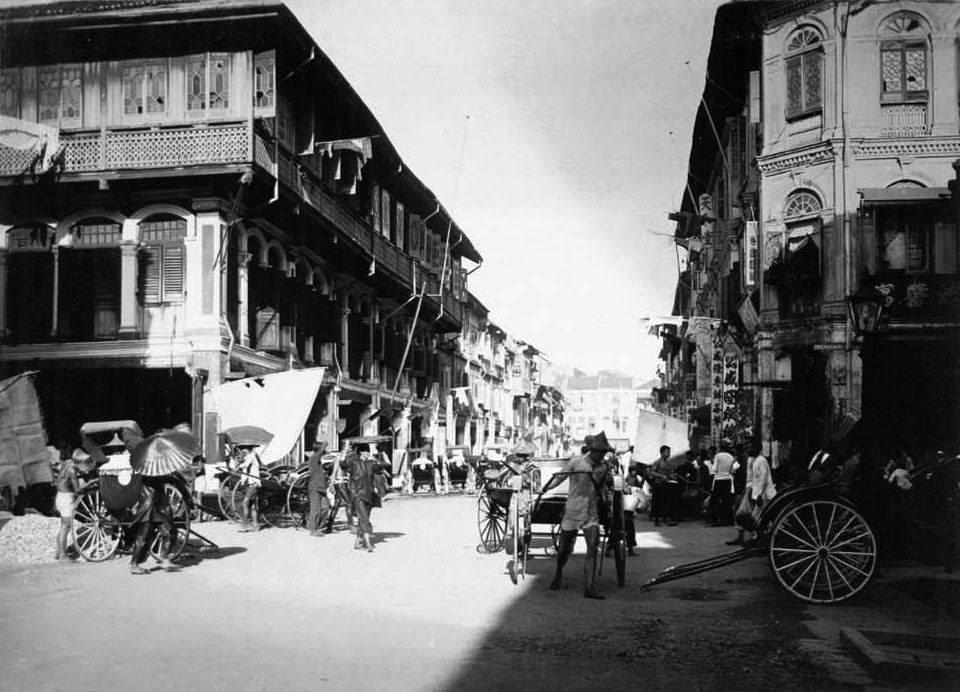
“Chinese Quarters – Showing a sideview of Lai Chun Yuen.” Souvenir of Singapore, 1914.
Lai Chun Yuen was designed by Regent Alfred Bidwell and built before 1887, and owned by Lin Dingxing (林鼎興). Occupying a three-storey shophouse, the 834-seat teahouse theatre was located on Smith Street (戲院街), which was known as Theatre Street and the nearby streets, Temple Street as Theatre Rear Street (戲院橫街), and Trengganu Street as Theatre Side Street (戲院後街). While it has the setting and seating arrangement of a traditional Chinese teahouse, it differs from street opera in that it is paid entertainment with individual seats for its audience. The teahouse theatre was located on Smith Street (戲院街), which was known as Theatre Street and the nearby streets, Temple Street as Theatre Rear Street (戲院橫街), and Trengganu Street as Theatre Side Street (戲院後街).
Although it adopts the traditional Chinese teahouse’s setting and seating style, it differs from street opera in that it offers paid entertainment with individual seats for spectators. The theatre was specially renovated in 1918 to replace rows of seats with a more intimate arrangement featuring tables and chairs. It was later divided into four seating classes, with the ground level accommodating the most seats — 40 first class, 56 second class, 237 third class, and 55 fourth class [Liu and Phillips 1988, 29].
Lai Chun Yuen was one of the most popular performance venues in Chinatown and emerged as a major hub for Cantonese wayang during the early twentieth century. It was renowned for hosting celebrated performers and troupes from China and Hong Kong who toured Southeast Asia. Its popularity was such that “full house” (满座) signs were said to be raised night after night [Yi 2015]. The theatre’s success also stimulated the growth of the surrounding district, helping to shape Chinatown into a vibrant centre for entertainment, leisure and dining. Up till the outbreak of World War II, Singapore was recognised as a key stop for travelling troupes, and many performers who appeared at Lai Chun Yuan later gained heightened prestige upon returning to China or Hong Kong as acclaimed “Nanyang returnees” (南洋回). Around 1940, the theatre was leased to the Shaw Brothers and renamed Sin Seng Theatre. It was destroyed by fire after the war.
Venue Location
Dates
Associated Performance(s)
| Performance Name | Performer | Production | Festival |
|---|---|---|---|
| Meng Hou Zhong (夢後鐘) |
Zhen Tian Sheng Troupe (中國振天聲社) (Troupe)
|
||
| Heiyu Honglian (黑獄紅蓮) |
Zhen Tian Sheng Troupe (中國振天聲社) (Troupe)
|
||
| Xiongfei jiangjun zhan si liuhua ta (熊飛將軍戰死榴花塔) |
Zhen Tian Sheng Troupe (中國振天聲社) (Troupe)
|
Media

“Chinese Quarters – Showing a sideview of Lai Chun Yuen.” Souvenir of Singapore, 1914.
Sources
Liu, Gretchen, and Phillips, Angeline, eds. Wayang: A history of Chinese opera in Singapore. National Archives of Singapore, 1988.
Yi, Yan. Liyuan shiji: Xinjiapo huazu difang xiqu zhi lu [Hundred Years Development of Singapore Chinese Opera]. Singapore: The Singapore Chinese Opera Institute, 2015.
Contributor
2026. “Lai Chun Yuen (梨春园)“. In Performing Archipelagos, edited by Kyueun Kim, Alvin Eng Hui Lim and Hedren Wai Yuan Sum. Singapore: National University of Singapore.