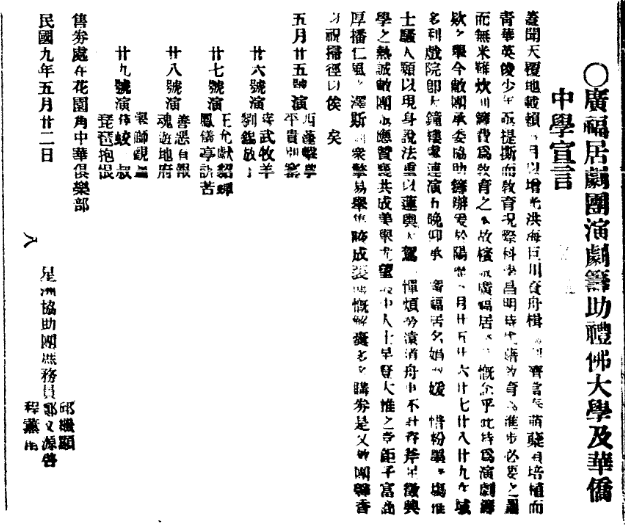
Zhen Wu Shan She; 新加坡振武善社; 禁吸鸦片协会; 新加坡拒毒会; 星洲拒毒會徴求
About
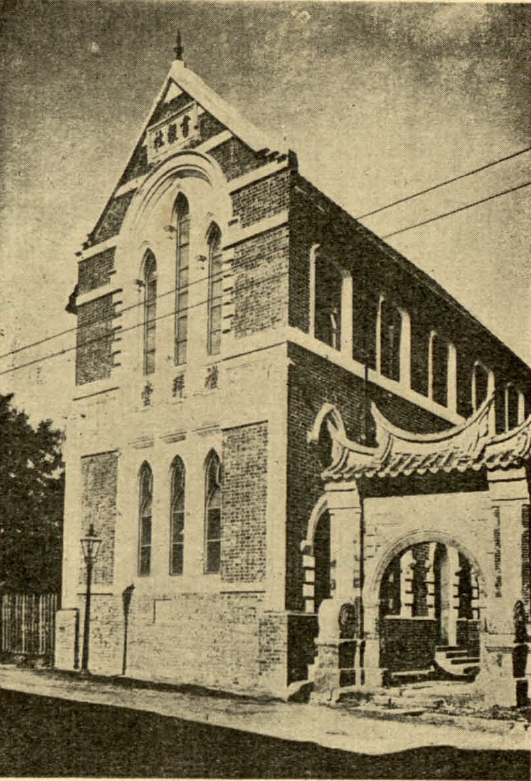
Singapore Reading Room (星洲书报社), where the first meeting was convened to set up the Singapore Anti-Opium Society (振武善社). In Zhang Yongfu, 南洋与创立民国 Nan yang yu chuan li min guo, 75. 上海: 上海中华書局, 1933.
The Singapore Anti-Opium Society, also known as 振武善社 (Zhen Wu Shan She), was a Chinese-led anti-opium and opium-cessation charitable organisation in Singapore. Its emergence is connected to a 1906 initiative to establish an opium-refuge and cessation facility under the encouragement of Sun Sze Ting (孙士鼎), the Chinese consul in Singapore after conversing with Dr Yin Suat Chuan (殷雪村), who delivered a lecture on “The Method of Managing an Opium Refuge supported by the Chinese Community” based on his experience with victims of the vice in his practice [Zhu & Wang 2024]. The idea was later significantly supported by local Chinese community figures, including the first Presbyterian Chinese pastor in Singapore, Tay Sek Tin (郑席珍), Tan Hung Chew (陈云秋), Tan Boo Liat (陈武烈), Wang Bangjie (王邦杰), Shen Lianfang (沈联芳), and 12 others. They convened a meeting at the Singapore Reading Room (星洲书报社) on the second floor of the Jubilee Church, which was attended by more than seventy people and reportedly raised $13,000 in a short period. Dr Yin and Dr Lim Boon Keng (林文庆) were named as volunteer doctors during the session.
The society was inaugurated on 10 July 1907 at the Chinese Chamber of Commerce on Hill Street (Strait Times 1907, 7), with around 500 Chinese participants in attendance. Among them were revolutionary leaders, such as Teo Eng Hock, Tan Chor Lam, Lim Nee Soon, and Lim Chwee Chian, who were also sponsors. Over the next few years, the society and its supporters promoted public education through various channels, such as publications, performances, and campaigns that aimed at warning overseas Chinese against opium use and encouraging cessation in addition to treatment, management and rehabilitation. Their establishments eventually became important platforms for propagating the Revolution [Lin, 2023a]. For instance, the Singapore Reading Room, founded by Zhen Wu Shan She, was the earliest known Chinese-language bookstore in Singapore and served as a gathering place for intellectuals, including supporters of reformers and revolutionaries speaking. In February-March 1909, the Society also hosted 振天声 (Zhen Tian Sheng), a Cantonese reformist opera troupe from Guangdong, China, to perform in Singapore [Lin, 2023b].
City
Supporter Type
Person (isSupportOf)
Troupe (isSupportOf)
Performance (isSupportOf)
| Performance | Date |
|---|---|
| Meng Hou Zhong (夢後鐘) (Chinese Opera or Wayang or Xiqu — Cantonese opera or Yueju) | 30-Jan-1909, 11-Feb-1909, 5-Mar-1909, 09-Mar-1909, 16-Mar-1909 – 30-Jan-1909, 11-Feb-1909, 5-Mar-1909, 09-Mar-1909, 16-Mar-1909 |
| Heiyu Honglian (黑獄紅蓮) (Chinese Opera or Wayang or Xiqu — Cantonese opera or Yueju) | 31-Jan-1909, 12-Feb-1909, 6-Mar-1909, 17-Mar-1909, 03-Apr-1909 – 31-Jan-1909, 12-Feb-1909, 6-Mar-1909, 18-Mar-1909, 04-Apr-1909 |
| Xiongfei jiangjun zhan si liuhua ta (熊飛將軍戰死榴花塔) (Chinese Opera or Wayang or Xiqu — Cantonese opera or Yueju) | 01-Feb-1909, 08-Mar-1909, 18-Mar-1909 – 01-Feb-1909, 08-Mar-1909, 18-Mar-1909 |
Production (isSupportOf)
Tour (isSupportOf)
| Tour | Period |
|---|---|
| Zhen Tian Sheng 1909 Nanyang Tour (Others) | 1909 – 1909 |
Media
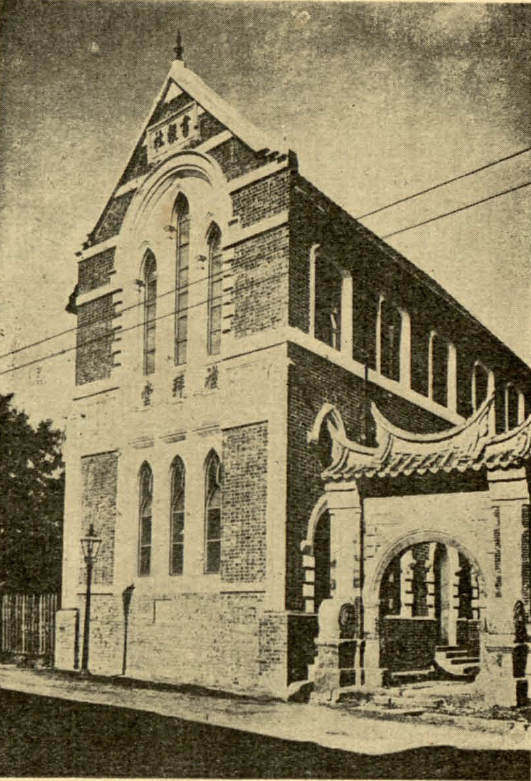
Singapore Reading Room (星洲书报社), where the first meeting was convened to set up the Singapore Anti-Opium Society (振武善社). In Zhang Yongfu, 南洋与创立民国 Nan yang yu chuan li min guo, 75. 上海: 上海中华書局, 1933.
Sources
Lin, Zhiqiang. 2023. “革命戏班振天声 在新加坡演出的反应.” The Straits Times. March 2.
Lin, Zhiqiang. 2023. “宣传革命的重要平台——话星洲书报社.” The Straits Times. September 21.
The Straits Times. 1907. “A Prevalent Vice.” July 11, 1907, 7.
Zhu, Qing, and Yuanlin Wang. 2024. “Chinese Christian Community in Modern Singapore: The Case of the Jubilee Church, 1883–1942.” Religions 15: 1284.
Contributor
2026. “Singapore Anti-Opium Society (振武善社)“. In Performing Archipelagos, edited by Kyueun Kim, Alvin Eng Hui Lim and Hedren Wai Yuan Sum. Singapore: National University of Singapore.