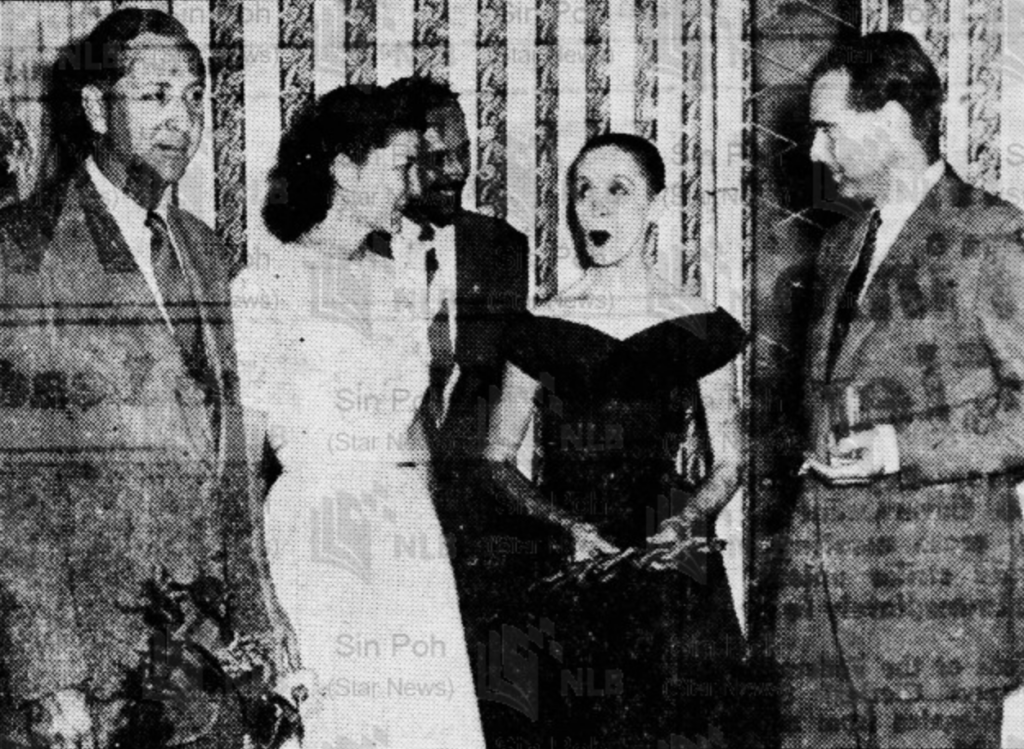
American musician & comedian who formed a vaudeville act with Lynn Cowan in 1912. They made two world tours, starting in 1920. Also toured the East as part of the Cowan and Bailey Review in the 1930s.
Settled in Singapore in 1936, and opened the Coconut Grove Cabaret in October 1936 with partner Lynn Cowan. Took over the resident band Kleinman’s Syncopators and renamed the group Cowan & Bailey’s Coconut Grove Syncopators.
Lynn Cowan was evacuated on a U.S., warship on Dec. 20, 1941. Bill Bailey stayed in Singapore and was interned in Changi Prison with his wife. In a post-war interview [Sunday Tribune, 1 February. 1948, p.2] Bill Bailey said that he “remained behind to see the war through” (which implies that it was a deliberate choice), however in a letter from his partner [Eastern Sun, 8 April 1971] Lynn Cowan states that “Bill and Gene could not reach the harbour to join us because of heavy bombing up town and we later learned they had been captured and interned in Changi Prison” (which clarifies that Bill and his wife were trapped in Singapore and did not stay by choice).
At the end of 1945 Bill Bailey reopened his Coconut Grove (at a different location).
Other Information
“TONIGHT’S BIG ATTRACTION AT RAFFLES – A really big and outstanding cabaret attraction begins a season tonight at Raffles Hotel in the shape of the Cowan and Bailey Revue. The fame of this combination, which is now engaged on a tour of the East, has already reached Singapore in advance and the management of the Hotel are confident that they have something really good which should draw all Singapore. The chief members of the company are Bill Bailey and Lynn Cowan, both of whom are amazingly versatile. They are headliners in American vaudeville, and their acts include selections on the piano, banjo and guitar, as well as songs and sensational character costume numbers. They also give an individual table entertainment in which they saunter round the room singing to each table as they come to it. Not only are they clever entertainers but Cowan is a song writer of some merit and both are well known in the cinema world… “ [Singapore Free Press, 8 June 1936, p.2]
TO HIM LIFE IS A LAUGH: Portrait of “B.B.” by Jee See Lian – Bill Bailey is a man with a recipe for right living. It is a simple one and is just this – “Never let worry worry you.” Life, according to him, is a big laugh in itself and so sunny is his own outlook that it acts like a tonic to those who know him. Bill embarked on his career as entertainer when he was seven. That was in the States. Playing no fewer than 14 musical instruments, of which the banjo was his specialty, his musical turns carried him from town to town, and, after successful appearances on the American stage, he started out on his first world-tour in 1920 forming a quartette with his charming wife and Mr. And Mrs. Lynn Cowan. From San Francisco, they proceeded to Australia, making appearances in Sydney and Melbourne. Then on to South Africa in the following year to play in Durban, Johannesburg and other cities. The principal towns in England were their next stepping-stones before they returned to the States. After a round of the American cities, they started off on their second world tour following practically the same route. Consequently, in 1935 on their third and last tour together, this quartette visited Japan, China, the Philippines, Java, Ceylon and Ultimately Singapore. That was in 1937 [actually 1936]. Singaporeans will remember that famous team – Cowan and Bailey – doing a successful season of 12 weeks at Raffles Hotel. Conditions were at the time so favourable, that very soon an enthusiastic public witnessed the opening of the well known Coconut Grove in Pasir Panjang Road. Cowan and Bailey gave Singapore a “new form of entertainment.” It was they who introduced the idea of “personal entertainment” at the parties’ tables playing and singing request tunes which ranged from ballads to naughty songs. Their character sketches which proved so popular, and which included Roman senators and Eskimoes, brought the house down! In 1939 they were the gay mirth makers at the cosy Cathay Cafe. At that time a group of charming artistes, mostly from California, where they were chiefly engaged in film work, were brought to Singapore to perform at this popular rendezvous. For a time they did wonderfully well for the novelty of an American night-spot was something to marvel at in those days. From the time of the fall of Dunkirk, Cowan and Bailey returned to their Pasir Panjang Coconut Grove. Then the Japs came into the picture and things took a different turn. By that time however Mr. and Mrs. Cowan had got safely away to Australia, while Mr. and Mrs. Bailey remained behind to see the war through. To put it cheerfully in Mr. Bailey’s words, “Changi was my winter home, and Sime Road my summer home.” However, as fate would have it, this brave couple came through the crisis. Christmas night in the liberation year was the date for the reopening of Bailey’s Coconut Grove – this time at No. 55, Cuppage Road. In those early months of Singapore’s regained freedom this night-spot was packed with officers. Today it is the civilians’ rendezvous for dinner and dancing. Bailey’s career has been a decidedly checked one. Fifty years of the stage has gained him a wealth of experience. No wonder he says, “I have seen plenty in my time – I have met all types of people the world over.” And the result of all this? Our inimitable and sturdy citizen of the world looks upon life – as a laugh! [Sunday Tribune, 1 February. 1948, p.2]
SORRY BILL BAILEY, by Laurie Lee – From Florida, U.S.A… a letter just to tell me Bill Bailey might be dead, but he’s not forgotten. It came from none other than Bill’s partner in show business since 1912, Lynn Cowan. He’d read my articles of March 19 where I revealed nobody had remembered it was the fifth anniversary of Bill Bailey’s death. I said Bill Bailey’s bar in Cuppage Street had now been taken over by bats and was largely used as a storehouse for cane furniture. But old Bill hasn’t been forgotten. “We had a wonderful career together and I want you to know that Bill Bailey will never be forgotten,” Mr. Cowan said in his letter. It turns out that Bill Bailey and Lynn Cowan teamed up in 1912 and didn’t separate until World War II when Bill and his wife Gene were captured. Mr. Cowan tells the story… “After years of appearing on the B. F. Keith and Orpheum Circuits of vaudeville and making two world tours, Bill and I joined Miss Betty Compson (the movie star) on her tour of Hawaii and the Far East. When Miss Compson decided to return to the States for motion picture commitments Bill and I decided to remain in the Far East and replay all the cities and countries we had replayed before. We met with great success… At Raffles Hotel in Singapore we broke all records for 16 weeks.” Bailey and Cowan fell in love with Singapore and decided to set up business here. They found a house in Pasir Panjang Road which they rented from a Mrs. Loh. “We converted it into the original Coconut Grove with a huge tract of coconut trees, Chinese temple and cable house locations,” Mr. Cowan said. The team made an “ill-fated plunge” when they started operating the Cathay Cafe and Roof Garden and they returned to the Coconut Grove “sadder but wiser.” Mr. Cowan said he was called into war service on December 20, 1941 and evacuated on a small U.S. freighter. “Bill and Gene could not reach the harbour to join us because of heavy bombing up town and we later learned they had been captured and interned in Changi Prison,” he said. Mr. Cowan did other return when Bill Bailey opened the second Coconut Grove. He came back in 1963 on a belated honeymoon with his new bride, Margaret Jane Brooks. He looked up old friends like Run Run and Runme Shaw… and of course Bill Bailey. “He said ‘Hello Partner’ just like it was yesterday we’d parted. And that is the way it always has been – Partners.” Mr. Cowan said their theme song Won’t You Come Home Bill Bailey was written in 1902 by Hugh Cannon and “Bill had always known about it and liked it.” Old Bill Bailey may have been buried here five years ago in a coffin draped with the U.S. flag, but this is not how his partner sees it. “He will always be coming home – he never left,” Mr. Cowan said. [Eastern Sun, 8 April 1971]