中國振天聲社 [中興日報 1909]; 振天聲慈善班 [槟城新报, 6 March 1909, 3]; 振天声剧团; 振天声 [Chen 1983; Xie, 1983]; Chan Thing Shing [The Straits Times, 18 March 1909]; Chinese Amateur Dramatic Co. [The Straits Times, 18 March 1909]; Chinese Amateur Dramatic Company of Hong Kong [Straits Echo, 18 March 1909, 4]; Ching Tin Seng Amateur Co. [Straits Echo, 18 March 1909, 4]; Chin Tian Seng Amateur Dramatic Co. of Hong Kong [The Straits Times, 25 March 1909, 7]; 振天sheng [Huang, 2019]; “Strike the Heavenly Voice” [Zhang, 2022]; 振天声剧社 [He, 2008]
About
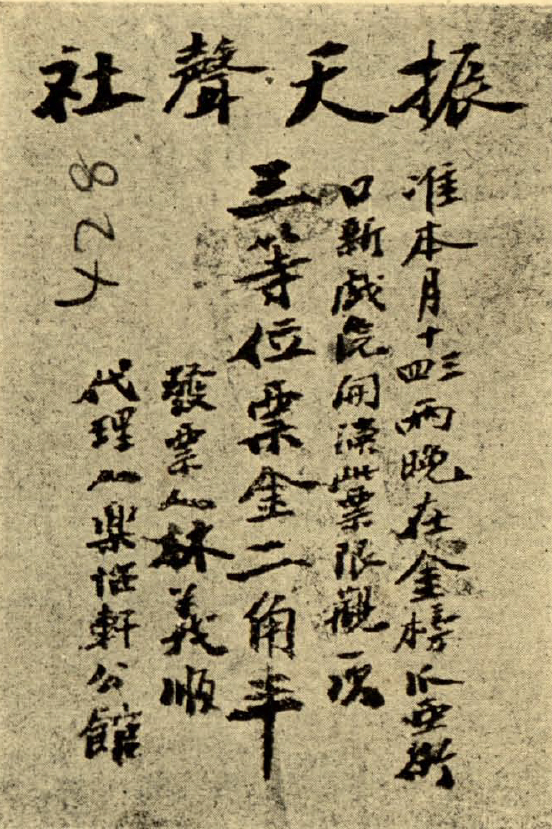
Performance ticket for Zhen Tian Sheng, kept by Tan Chor Lam (陈楚楠, Chen Chunan), President of the Singapore Branch of Tongmenghui. In Zhang Yongfu, 南洋与创立民国 Nan yang yu chuan li min guo, 74. 上海: 上海中华書局, 1933.
Formed in 1908 in Hong Kong, Zhen Tian Sheng (振天聲) was a pioneering Cantonese reformist theatre troupe—often described as a zhishi ban (志士班), or “patriotic activists’ troupe”—that emerged amid the wave of political mobilisation in the late Qing. Its members, including their troupe leader Chen Tiejun (陳鐵軍), came from earlier Cantonese opera circles with links to groups such as 優天影劇團 (You Tian Ying Theatre Troupe) and reoriented performance towards public persuasion. This broader strategy—leveraging Cantonese opera and “new plays” for political work—has been traced to earlier experiments such as Cainan Ge Ju She (采南歌劇社), also known as Tianyan Company (天演公司), founded in Guangzhou in 1904 to tap students’ and intellectuals’ enthusiasm for reading and reformist ideas [Feng 1940, 242].
Zhen Tian Sheng distinguished itself through a strong social conscience and an explicit commitment to political reform. Rather than relying on conventional operatic repertory, it promoted “improvement dramas” that condemned official corruption, oppressive customs, and superstition, presenting theatre as a vehicle for civic awakening. Works such as Meng Hou Zhong《夢後鐘》, Hei Yu Hong Lian 《黑獄紅蓮》, and Xiong Fei Jiang Jun Zhan Si Liu Hua Ta 《熊飛將軍戰死榴花塔》 exemplified this orientation and helped the troupe build audiences across Hong Kong and Macau, as well as in Nanyang—including Malaya and Singapore—often in an atmosphere shaped by resistance from conservative and royalist interests.
Revered by supporters as a “revolutionary troupe”, Zhen Tian Sheng did more than raise funds for humanitarian causes: it disseminated reformist and revolutionary ideas among Chinese diaspora communities through a newly reformed repertoire and public-facing performances. Accounts also associate the troupe with Sun Yat-sen (孙中山)’s revolutionary networks [Feng 1940, 242; Zhang 1933, 74]. During their Singapore tour in March 1909, troupe representatives were received by Sun Yat-sen at the Tongmenghui headquarters in 晚晴园 (Wan Qing Yuan), affirming their symbolic affiliation with the revolutionary movement.
The troupe’s activities, however, were short-lived. Following a successful tour of Nanyang from January to April 1909, Zhen Tian Sheng returned to Hong Kong. Soon after, it was forced to disband after royalists (保皇堂) reportedly tipped off Qing officials about its revolutionary activities [Feng 1940, 242]. Even so, its influence continued through successor formations and experiments. Shortly after dissolution, members merged with Hong Kong’s Xian Shen Shuo Fa She (現身說法社) to form Zhen Nan Tian (振南天) in 1910, though this venture reportedly collapsed within months due to a lack of funds. In 1911, some former members—led by Chen Shaobai (陳少白) and Huang Yongtai (黃詠臺)—established Zhen Tian Sheng Baihua Ju She (振天聲白話劇社) with a $1,000 loan from the Hong Kong businessman Chen Gengru (陳庚如), shifting to modern spoken drama and wenmingxi (文明戲). In this sense, Zhen Tian Sheng’s legacy lies not only in its brief performing life, but in the way it helped catalyse a transition from operatic reform to broader modern theatrical forms across the South China Sea.
Established Date
Genre
Troupe Organisation
Travel (Tours and Routes)
| Departure Date | From | Arrival Date | To | Via |
|---|---|---|---|---|
| [24-Jan-1909] | Hong Kong | 23-Jan-1909 | Singapore | – |
|
Transportation Mode
Maritime
|
Transportation Line Description
ss. Kum Sang or ss Kumsang (金生輪船) |
|||
|
Location Factor
Audience demographics; Economic opportunities; Logistical feasibility
|
Location Description
Zhen Tian Sheng travelled from Hong Kong aboard the steamship SS Kam Sung (金生輪船), which was supported and invited by the Hong Kong Ba Yi Office (香港八邑公所). This office is consistently mentioned in the troupe’s notices as the main organiser behind their Nanyang dispatch and fundraising efforts [中興日報 1909-01-28; 中興日報 1909-01-29]. Shipping news reported that the SS Kam Sung arrived in Singapore, likely on or before January 24, 1909, coming from Hong Kong; this was possibly the troupe’s vessel [Strait Times 1909-01-24]. Huang Yongtai (黃詠臺), a representative associated with the Ba Yi Office, seems to have travelled ahead of the troupe, as he is recorded arriving in Kuala Lumpur on January 23, 1909, to begin organising arrangements [南洋總匯新報 1909-01-29]. |
|||
|
Associated Venues
–
|
||||
| Departure Date | From | Arrival Date | To | Via |
|---|---|---|---|---|
| 29-Jan-1909 or earlier | Singapore | 30-Jan-1909 | Kuala Lumpur | – |
|
Transportation Mode
Maritime
|
Transportation Line Description
–
|
|||
|
Location Factor
Economic opportunities; Cultural affinity; Logistical feasibility
|
Location Description
Kuala Lumpur (吉隆/吉隆坡) marked the first recorded performance stop for their Nanyang tour. They arrived by steamship on 27 January 1909 (or the sixth day of the Lunar month), initially, before performing on 30 January [南洋總匯新報 1909-01-29; 1909-02-05]. Before the troupe’s arrival, Huang Yongtai (黃詠臺) reached Kuala Lumpur on 23 January by train to meet with local merchants and association leaders, including individuals such as Lu Qiujie (陸秋傑), Li Guanglin (李廣霖), and Tang Deyan (唐德衍), who were connected to the Kuala Lumpur Anti-opium/Zhenwu Society (吉隆振武社), as per the reports. He was hosted by Xie Renfu (謝仁甫). A planning session was conducted on 26 January to finalise arrangements for the reception, venue access, and ticket sales. |
|||
|
Associated Venues
–
|
||||
| Departure Date | From | Arrival Date | To | Via |
|---|---|---|---|---|
| 4-Feb-1909 or earlier | Kuala Lumpur | 4-Feb-1909 | Seremban | – |
|
Transportation Mode
Rail
|
Transportation Line Description
–
|
|||
|
Location Factor
Audience demographics; Economic opportunities; Logistical feasibility
|
Location Description
From Kuala Lumpur, the troupe set out for Seremban (芙蓉) and began performing on 4 Feb 1909 (or the 14th day of the Lunar month) before proceeding to Ipoh (霸羅) [南洋總匯新報 1909-02-05; 中興日報 1909-02-06]. Huang Yongtai (黃詠臺) had left for Seremban earlier on 12 Feb at around 4 pm, ahead of the rest of the troupe. |
|||
|
Associated Venues
–
|
||||
| Departure Date | From | Arrival Date | To | Via |
|---|---|---|---|---|
| 8-Feb-1909 | Seremban | 8-Feb-1909 | Kuala Lumpur | – |
|
Transportation Mode
Rail
|
Transportation Line Description
–
|
|||
|
Location Factor
Logistical feasibility
|
Location Description
The troupe returned to Kuala Lumpur (吉隆/吉隆坡) from Seremban (芙蓉) on 8 February 1909 (十八日). Separately, an article notes that the troupe faced high venue rental costs in Seremban, which could force a return to Kuala Lumpur [中興日報 1909-02-20]. No reception party met them on arrival; instead, a clerk from the Kuala Lumpur Anti-opium Association or Zhenwu Society (吉隆振武社) circle escorted them to stay overnight at the Kuala Lumpur Chinese Chamber of Commerce (吉隆商會) building [南洋總匯新報 1909-02-13]. There is no record of any performances. |
|||
|
Associated Venues
–
|
||||
| Departure Date | From | Arrival Date | To | Via |
|---|---|---|---|---|
| 9-Feb-1909 | Kuala Lumpur | 9-Feb-1909 | Ipoh, Perak | – |
|
Transportation Mode
Rail
|
Transportation Line Description
–
|
|||
|
Location Factor
Audience demographics; Economic opportunities; Cultural affinity; Logistical feasibility
|
Location Description
The troupe took the 7:45 a.m. train from Kuala Lumpur (吉隆/吉隆坡) to Ipoh (霸羅/垻羅/巴羅) [南洋總匯新報 1909-02-13]. In Ipoh, hosting and coordination were organised through Perak Le Shan Tang (比叻樂善堂) and the “Gailiang shangju” (新改良商局) committee, with Lin Ziwen (林子文) elected committee chair and He Bailing (何百龄) proposed to welcome the troupe [南洋總匯新報 1909-02-09]. Reports describe a structured reception and logistical support, including station welcome, accommodation arrangements, and expense coverage tied to ticketing/accounting practices, with performances taking place following arrival [南洋總匯新報 1909-02-09; 中興日報 1909-02-16]. |
|||
|
Associated Venues
–
|
||||
| Departure Date | From | Arrival Date | To | Via |
|---|---|---|---|---|
| 16-Feb-1909 – 17-Feb-1909 | Ipoh, Perak | 16-Feb-1909 – 17-Feb-1909 | Kampar, Perak | – |
|
Transportation Mode
Rail
|
Transportation Line Description
–
|
|||
|
Location Factor
Audience demographics; Economic opportunities; Logistical feasibility
|
Location Description
Kampar (金寶) is confirmed as a performance stop in later Perak (霹靂) circuit summaries, where receipts/expenses are reviewed, and proceeds are framed as being channelled through the relief arrangements of the Hong Kong Ba Yi Office (香港八邑公所) [中興日報 1909-03-06; 南洋總匯新報 1909-03-06]. Exact travel dates and the number of performance nights in Kampar are not stated. Support is described generally as local associations/businessmen covering costs. |
|||
|
Associated Venues
–
|
||||
| Departure Date | From | Arrival Date | To | Via |
|---|---|---|---|---|
| 23-Feb-1909 or earlier | Kampar, Perak | 23-Feb-1909 or earlier | Gopeng, Perak | – |
|
Transportation Mode
Rail
|
Transportation Line Description
–
|
|||
|
Location Factor
Audience demographics; Economic opportunities; Cultural affinity; Logistical feasibility
|
Location Description
The Gopeng (務邊/務兵) engagement is described as a three-night run (23–26 Feb 1909). Expenses were underwritten locally—most explicitly, one report states the theatre was loaned by Yu Jiqing (余吉卿), and other costs were covered by local businessmen, allowing nearly all receipts to be transferred to the Hong Kong Ba Yi Office (香港八邑公所) for relief efforts [中興日報 1909-03-05; 1909-03-06 南洋總匯新報 1909-03-06]. |
|||
|
Associated Venues
–
|
||||
| Departure Date | From | Arrival Date | To | Via |
|---|---|---|---|---|
| 27-Feb-1909 | Gopeng, Perak | 27-Feb-1909 | Taiping, Perak | Ipoh, Perak |
|
Transportation Mode
Rail
|
Transportation Line Description
–
|
|||
|
Location Factor
Audience demographics; Economic opportunities; Cultural affinity; Logistical feasibility
|
Location Description
The troupe travelled by train from Gopeng (務邊/務兵) to Taiping (太平) on February 27, which was the 8th day of the Lunar month. They made a stop in Ipoh along the way, where Wenming Ge (文明閣) organised a tea reception. Performances were held consecutively from February 28 to March 2 [中興日報 1909-03-06; 南洋總匯新報 1909-03-06]. |
|||
|
Associated Venues
–
|
||||
| Departure Date | From | Arrival Date | To | Via |
|---|---|---|---|---|
| 4-Mar-1909 | Taiping, Perak | 4-Mar-1909 | Penang | Prai (Perai) |
|
Transportation Mode
Inland Water; Rail
|
Transportation Line Description
–
|
|||
|
Location Factor
Audience demographics; Economic opportunities; Cultural affinity; Logistical feasibility
|
Location Description
Penang (庇能) was organised in advance as a major stop, facilitated by a committee and a clearly planned reception route. Prior to the troupe’s arrival, local Chinese leaders convened to arrange the welcome and engagement, centring activities around the Penang Chinese Town Hall (平章公館) and planned performances at Drury Lane Theatre, also known as “Puqing xiyuan” (普慶戲院) [Straits Echo 1909-02-24; 槟城新报 1909-03-04]. A subsequent meeting established a 12-member reception and organising committee, with Mr Leong Kok Hing (梁樂卿) serving as president. They outlined a two-part reception plan: one group would travel to Prai/Perai to meet the troupe and escort them onward, while another group would meet them at the railway pier and bring them to the Chinese Town Hall. The references to Prai/Perai and the railway pier indicate that the troupe would arrive by rail to the mainland (Prai/Perai), followed by a short ferry or boat ride to Penang Island, where the reception would continue at the pier [Straits Echo 1909-02-26]. The troupe is recorded to have arrived in Penang from Taiping on March 4, 1909, and began performances on March 5. Following the performances, Chinese-language reports detailed the reception at the station and its connection to Ba Yi relief fundraising, as well as the specific roles assigned to the committee for coordination and accounting [Straits Echo 1909-03-04; 檳城新報 1909-03-05; 中興日報 1909-03-05; 南洋總匯新報 1909-03-08]. |
|||
|
Associated Venues
Pok Hing Theatre (普慶戲院)
|
||||
| Departure Date | From | Arrival Date | To | Via |
|---|---|---|---|---|
| 12-Mar-1909 | Penang | 14-Mar-1909 | Singapore | – |
|
Transportation Mode
Maritime
|
Transportation Line Description
ss Rotorua (洛打拿) – An assumption that 洛打拿 (Luo Da Na) is ss Rotorua, which left for Singapore on the 12th of March 1909 [Pinang Gazette and Straits Chronicle, 15 March 1909]. |
|||
|
Location Factor
Audience demographics; Economic opportunities; Cultural affinity; Logistical feasibility
|
Location Description
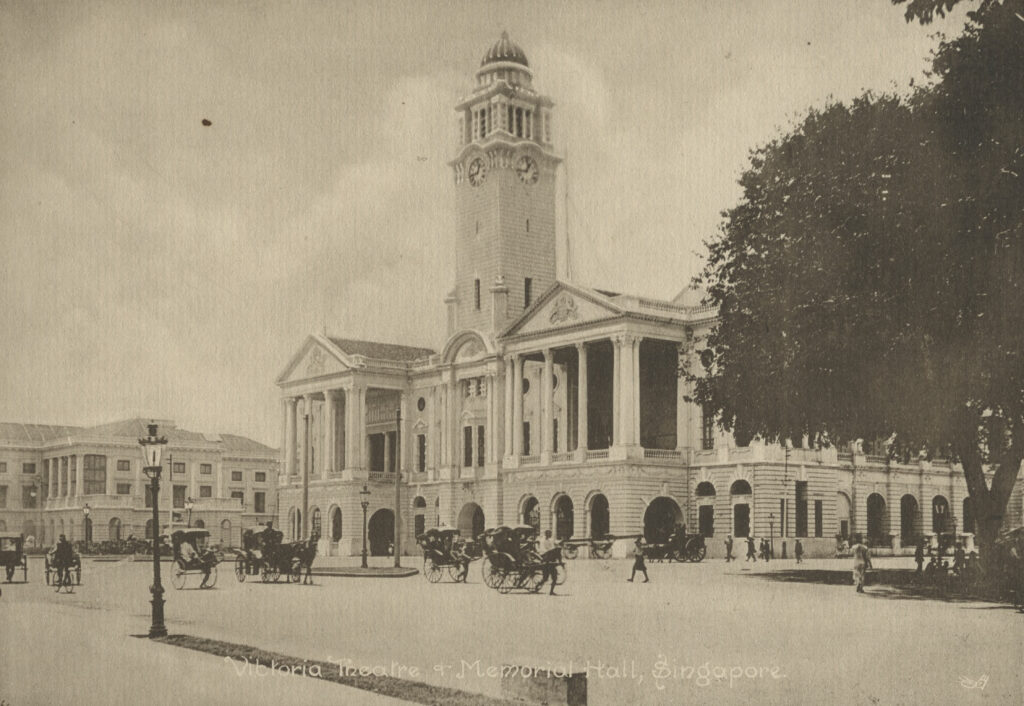
Singapore was prepared as a key stop through advance bookings, organised reception efforts, and multiple layers of local sponsorship. A telegram reports that the troupe would arrive from Penang on March 14, 1909, via SS Rotorua (洛搭拿船), and that the Singapore Anti-Opium Society (新加坡振武善社) had already secured Lai Chun Yuen (梨春園) for performances starting March 16, indicating prior negotiations and coordination with the venue [中興日報 1909-03-11]. Upon arrival, they were welcomed at the harbour by dozens of representatives and businessmen and taken to the society, illustrating how networks managed reception and hosting logistics [中興日報 1909-03-15]. As the season continued, sponsorship expanded beyond the Anti-opium Society, with new organisations enabling engagements at different venues. The Fairy Dale Association (華里園) gathered local business leaders and took charge of organising additional shows at the Theatre Royal / “New Theatre” on North Bridge Road (Arab Street junction), demonstrating how organisational efforts and venue access were adaptable under new hosts [中興日報 1909-03-24; 中興日報 1909-03-25; 叻报 1909-03-27]. A final hosting change in Singapore reveals another layer of support: Yue Yi Xuan Gong Guan 樂怡軒公館 (also called Xiao Tao Yuan Ju Le Bu 小桃園俱樂部), backed by Chinese business interests including arrangements linked to Tan Boon Liat 陳武烈, handled the logistics of the last engagement. This was described in the press as “renting again” (又租), highlighting their role in logistical management [中興日報 1909-03-30; 叻报 1909-03-31; 中興日報 1909-04-06]. |
|||
|
Associated Venues
Lai Chun Yuen (梨春园); Theatre Royal
|
||||
| Departure Date | From | Arrival Date | To | Via |
|---|---|---|---|---|
| 10-Apr-1909 | Singapore | – | Bangkok, Siam | – |
|
Transportation Mode
Maritime
|
Transportation Line Description
–
|
|||
|
Location Factor
Economic opportunities; Cultural affinity; Logistical feasibility
|
Location Description
The troupe departed Singapore for Bangkok (濱角), Siam (暹羅) by boat on 10 Apr 1909, with a send-off by representatives of supporting bodies and businesses [中興日報 1909-04-10]. English-language reports also describe the move as responding to requests from the Chinese in Bangkok and note that the troupe had left for Bangkok by 13 Apr 1909. [Strait Times 1909-04-10; Straits Echo 1909-04-13] Telegram notices record Siam Chinese merchants’ enquiries about vessel and routing around late March [中興日報 1909-03-30; 叻报 1909-03-31]. |
|||
|
Associated Venues
–
|
||||
| Departure Date | From | Arrival Date | To | Via |
|---|---|---|---|---|
| Nov-1908 | Hong Kong | Nov-1908 | Singapore | – |
|
Transportation Mode
–
|
Transportation Line Description
–
|
|||
|
Location Factor
Audience demographics; Cultural affinity
|
Location Description
A performance poster at Lai Chun Yuan, featuring prominent figures from the Tongmenghui (同門會), such as Huang Xing (黃興), Hu Hanmin (胡漢民), and Wang Jingwei (汪精衞). This poster is believed to have been used to represent performances by Zhen Tian Sheng in November 1908, when Sun Yat-Sen (孫中山) watched and gave a speech on the Revolution during the intermission. However, records vary, with some noting that Zhen Tian Sheng’s first performance in Singapore was on 30 Jan 1909. Nevertheless, this poster still features some of the earliest photographs of Lai Chun Yuan and its connection with revolutionary efforts. No records or evidence have been found concerning the performance or the poster. Based on the arrangement of the visual elements, this poster appears to have been created later. The poster referenced in the publication and mentioned in connection with such a performance was actually cited in more recent newspapers [联合早报, 2017]. There were writings that mentioned that Zheng Tian Sheng had arrived before Jan 1909. During this period, they interacted with Sun Yat-Sen, with some members joining the Tongmenhui [Feng 1940, 245; Wang and Yang 2022, 88; Xie 1983, 244]. |
|||
|
Associated Venues
–
|
||||
Support (hasSupport)
| Supporter Name | Type of Support | Support Description |
|---|---|---|
| Sun Yat-sen (Individual) | Patronage | – |
| Fairydale Association (Clan, association and society) | Brokerage; Cultural; Financial; Logistical | – |
| Hong Kong Ba Yi Office (香港八邑公所) (Clan, association and society) | Financial |
The Hong Kong Ba Yi Office served as the primary financial sponsor for the troupe’s Southeast Asia tour. In a show of collective responsibility, the organisation prepaid $1,000 towards the tour’s expenses and arranged for eight guarantors to bear any financial losses incurred. |
| Lin Hangwei (林航葦) (Agent) | Cultural; Distribution; Others |
Lin Hangwei initiated the founding of Min Duo She (民铎社) to reform and promote new drama, directing new performances to meet the local audience’s needs. |
Context
Formed in 1908 after You Tian Ying (优天影) dissolved, Zhen Tian Sheng (振天声) was rooted in Guangzhou, with its address reportedly set at Lizhiwan Pengyuan (荔枝湾彭园) [Chen 1983, 295]. From this Guangzhou foothold, the troupe travelled across the Pearl River Delta circuit across Guangdong, Hong Kong, and Macau to rehearse and perform. In late 1908, state regulation reshaped its geography: after the deaths of the Guangxu Emperor (光绪帝) and Empress Dowager Cixi (慈禧太后) on 14–15 November and the ensuing ban on performances under Qing mourning regulations (国丧例禁演戏), the troupe shifted south to perform in Nanyang (南洋).
Zhen Tian Sheng’s artistic direction is described as politically charged, with scripts that promoted Chinese nationalism (民族主义) and were regarded as more forceful than earlier zhishi ban (志士班), reflecting the late-Qing climate in which theatre served as a vehicle for public mobilisation and debate [Chen 1983, 295]. The troupe’s historical trajectory—especially the 1908 national mourning restrictions that suspended performances and the later denunciation by the royalists (保皇党)—highlights how imperial politics and revolutionary-era tensions directly shaped what could be staged, where it could circulate, and how long the troupe could survive, culminating in its compelled dissolution shortly after their return to China in 1909.
Associated Performance(s)
| Performance Name | Production | Festival | Tour |
|---|---|---|---|
| Meng Hou Zhong (夢後鐘) | |||
| Heiyu Honglian (黑獄紅蓮) | |||
| Xiongfei jiangjun zhan si liuhua ta (熊飛將軍戰死榴花塔) |
Media
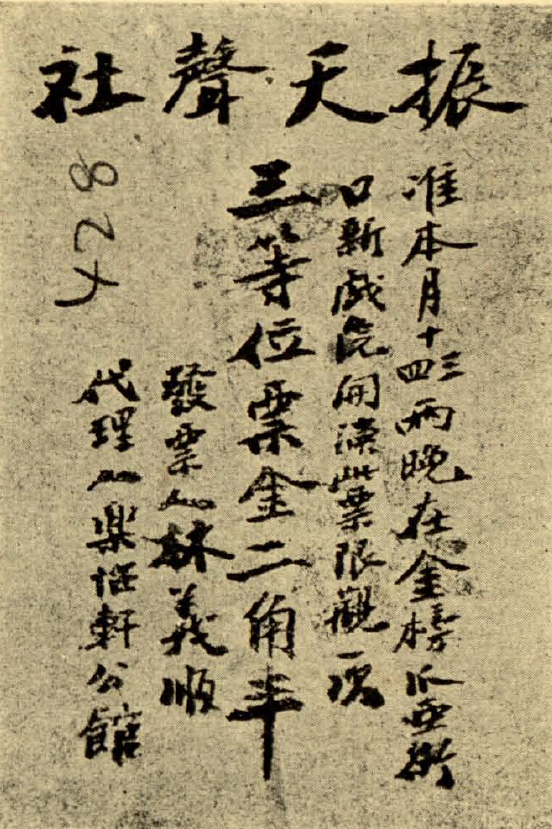
Performance ticket for Zhen Tian Sheng, kept by Tan Chor Lam (陈楚楠, Chen Chunan), President of the Singapore Branch of Tongmenghui. In Zhang Yongfu, 南洋与创立民国 Nan yang yu chuan li min guo, 74. 上海: 上海中华書局, 1933.
Sources
Chen, Huaxin. 1983. “粤剧与辛亥革命 Yueju yu Xinhai geming” [Cantonese opera and the 1911 Revolution]. In 粤剧研究资料选 Yueju yanjiu ziliao xuan [Sources for research on Cantonese opera), edited by Guangdong sheng xiju yanjiu shi, 289–307. Guangzhou: Guangdongsheng Xiju Yanjiu Shi.
Feng, Zhiyou. 1940. 革命逸史 Geming yishi [An anecdotal history of the Revolution ]. Vol. 2. 商務印書館.
He, Jie Chang. 2008. “团体 机构 场所 Tuanti jigou changsuo” [Troups, Organisations, Venues]. In Yueju da ci dian 粤剧大辞典 [Dictionary of Cantonese Opera], edited by 编纂委员会 [Editorial Committee], 735-850. Guangzhou: Guangzhou chuban she.
Huang, Lu & Yang, Min. 2022. “从乡士仪式到族群标识: 20世纪初粤剧在东南亚的传播发展研究 [From Rural Rituals to Ethnic Identity: A Study of the Spread and Development of Cantonese Opera in Southeast Asia in the Early 20th Century].” Hundred Schools in Arts 186, 3: 87-93.
Huang, Ziming. 2019. 优影振天声:牛车水百年文化历程 Youying Zhen Tian Sheng: Niucheshui bainian wenhua licheng [Chinese opera troupe Zhen Tian Sheng: One-hundred-year history of Singapore’s Chinatown]. Singapore: Bafang Wenhua.
Xie, Bingchou. 1983. “近代中国戏曲的民主革命色彩和粤剧的改良运动 Jindai zhongguo xiqu de mingzhugeming secai he yueju de gailiang yundong” [The revolutionary and democratic opera reform of modern China]. In 粤剧研究资料选 Yueju yanjiu ziliao xuan [Sources for research on Cantonese opera], edited by Guangdong sheng xiju yanjiu shi, 226–88. Guangzhou: Guangdongsheng Xiju Yanjiu Shi.
Zhang, Beiyu. “Cantonese opera troupes in Southeast Asia.” Asian Ethnology 81, no. 1/2 (2022): 83-106.
Zhang, Yongfu. 1933 南洋与创立民国 Nan yang yu chuan li min guo, 74. 上海: 上海中华書局.
Contributor
2026. “Zhen Tian Sheng Troupe (中國振天聲社)”. In Performing Archipelagos, edited by Kyueun Kim, Alvin Eng Hui Lim and Hedren Wai Yuan Sum. Singapore: National University of Singapore.